966
966




“APPROVED”
State Committee for Securities under the President of the Republic of Azerbaijan
Order No. 022
2 February 2000
Chairman_______________ H. Babayev
(in the wording of Orders No. 066 dated of 11 April 2002 and Order No. 074 dated of 25 May 2004)
REGULATİON ON CIRCULATION OF PROMISSORY NOTES IN THE REPUBLIC OF AZERBAIJAN
This Regulation has been developed in accordance with the Civil Code of the Republic of Azerbaijan and the “Regulation on the State Committee for Securities under the President of the Republic of Azerbaijan” approved by the Decree No.161 dated 26 July 1999 of the President of the Republic of Azerbaijan.
I. General provisions
1.1. This Regulation regulate the issuance, purchase, sale, transfer of promissory notes (hereinafter - promissory note) in the Republic of Azerbaijan, as well as the fulfillment of obligations under promissory notes and other operations related to the circulation of promissory notes.
1.2. Regardless of the form of ownership, all legal entities and individuals in the Republic of Azerbaijan (except for organizations financed from the budget) may use the promissory note in mutual settlements.
1.3. The following terms shall be used for the purposes of this Regulation:
- Promissory note - is a security, clearly drawn up in the form approved by the legislation, which reflects a written promise and entitles the holder (promissory note holder) the right to demand unconditionally the certain amount specified in the promissory note from the issuer, debtor or the person who undertook to pay the promissory note amount.
- Transfer promissory note - is a written order by a drawer that binds a drawee to make unconditional payment of a certain amount specified in the promissory note to the payee (remitter) within the period specified in the promissory note (Appendix 1).
- Drawer – a person who writes a transfer promissory note;
- Drawee – a person that pays a transfer promissory note;
- Payee (remitter) – a person that receives the sum specified in the transfer promissory note;
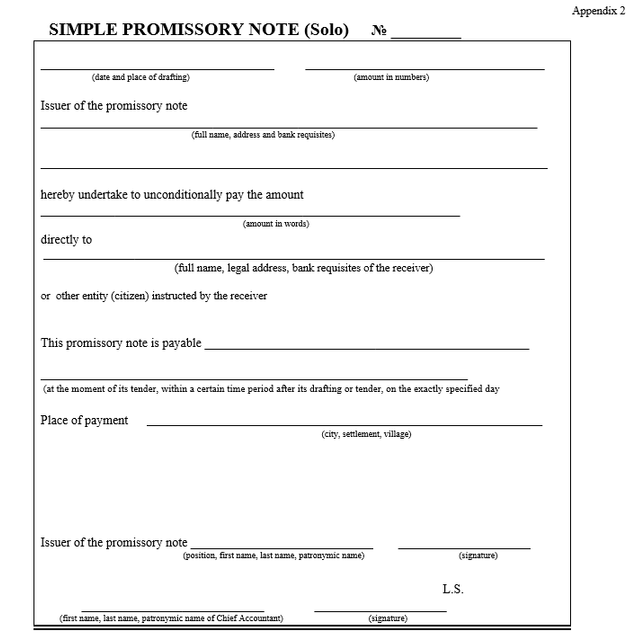
- Own (solo) promissory note - is a security that expresses the obligation undertaken by the drawer to unconditionally pay the amount specified in the promissory note to the holder of the promissory note when required or at another specified time (Appendix 2);
- Aval (a promissory note surety) - is a promissory note surety of the person who assumes responsibility for the fulfillment of the obligations of the person signed the promissory note or other persons liable for the promissory note;
- Guarantor – a person providing surety (2);
- Acceptance - is the consent of the payer (drawee) indicated in the promissory note by the promissory note issuer to pay the amount of the promissory note at the time specified in the promissory note by signing the promissory note or writing an appropriate statement;
- Acceptor – a person who has accepted a transfer promissory note;
- Allonge – a slip of paper attached to the promissory note for writing notes, formalizing avals, acceptances and etc.;
- Discount – an amount received by accounting organizations during the registration of promissory notes;
- Endorsement - a transfer note in a promissory note that transfers all rights arising from the promissory note from the last holder of the promissory note to the next holder;
- Endorser - a person who issues an endorsement;
- Endorsee – a person to whom a promissory note is transferred on the basis of an endorsement;
- Protest of a bill - official confirmation of the facts of refusal of acceptance or payment by the authorized state body (notary);
- Recourse – a reverse claim of the holder of a promissory note to the issuer of the promissory note, endorsers, depositors and other persons liable for the promissory note to reimburse the amount of the promissory note.
II. Transfer promissory note
2.1 A transfer promissory note shall have the following requisites:
a) name “promissory note” included in the text of a document;
b) offer to unconditionally pay a certain amount indicated in words and numbers;
c) full name, legal address and bank requisites of a person (payer) responsible for payment;
d) term of payment;
e) place of execution of payment;
f) full name, legal address, bank requisites of a remitter or a person whose instruction of payment is to be carried out;
g) date and place of drafting of a promissory note;
h) stamped signature of the promissory note issuer;
i) name of the printing house that printed the promissory note form, and the number, date and TIN (Taxpayer Identification Number) of the license issued by the State Committee on Securities under the President of the Republic of Azerbaijan (hereinafter - SCS).
2.2. With the exception of the following circumstances, a document lacking any of the requisites specified in the first paragraph of this section shall not have a force of a transfer promissory note:
a) a transfer promissory note lacking a term of payment shall be considered to be a promissory note for which a payment shall be carried out upon presentation;
b) in the event a place of payment has not been specifically indicated, the place indicated near a payer’s name shall be considered as a place of payment, and together with it, as a payer’s place of residence or place of stay;
c) a transfer promissory note lacking a place of its drafting shall be considered signed at the place indicated near the name of a person issuing a promissory note;
2.3. A transfer promissory note may be issued upon personal instruction of issuing it person, may be issued to a person issuing it or at the expense of a third person.
2.4. A transfer promissory note may be payable at the place of a third person, at the place of a payer, or at any other place.
2.5. A person issuing a promissory note may include in a transfer promissory note payable upon presentation or within a certain time period after presentation a condition on accrual of the interest on a promissory note’s amount. The rate of interest shall be indicated in such promissory note. In the event a day of accrual of interest has not been specified, it shall accrue from the day of drafting of a promissory note.
2.6. In the event the amount of a transfer promissory note has been specified in words and in numbers, the amount of a promissory note indicated in writing shall have preponderance in the event of a discrepancy between them. In the event the amount in a transfer promissory note has been specified several times in writing and several times in numbers, the lesser amount of a promissory note shall have preponderance in the event of a discrepancy between them.
2.7. In the event a transfer promissory note has signatures of persons not capable of undertaking obligations in respect of a promissory note, has false signatures or signatures of fictitious persons or unauthorized signatures, signatures of other persons shall not lose their force.
2.8. Any person signing a transfer promissory note as a person’s representative without obtaining an authority to act on his behalf shall personally bear obligations in respect of a promissory note, and where he has carried out payment in respect of a promissory note, he shall possess the rights which a person represented by him could have. Representative exceeding his authority shall equally be in the same position.
2.9. A person issuing a promissory note shall bear liability for acceptance and payment of a promissory note.
III. Endorsement
3.1. Any transfer promissory note may be transferred to another person by its endorsement.
Endorsement may also be executed for the benefit of a person issuing a promissory note or any other person obligated in accordance with a promissory note. This shall be in force in respect of a payer regardless of his acceptance or non-acceptance of a promissory note. These persons may also transfer a promissory note by endorsement.
3.2. An endorsement shall be simple and unconditional. Any condition restricting it shall be deemed unwritten.
A partially written endorsement is invalid.
An endorsement written to the presenter shall have the force of a blank endorsement.
3.3. The endorsement shall be written on the back of the promissory note or on the allonge and signed by the endorser. The name of the person in whose favor the endorsement is written may not be indicated in the endorsement, or it may consist only of the signature of the endorser (blank endorsement).
3.4. The endorsement shall transfer all rights arising from the promissory note. If it is a blank endorsement, the holder of the promissory note:
1) fill in the form in his own name or in the name of any other person;
2) may endorse a promissory note on a blank form or re-transfer the promissory note to any other person by endorsement;
3) may transfer a promissory note to another person without filling out the form and writing an endorsement.
3.5. Unless otherwise specified, the endorser shall be responsible for the acceptance and payment of the promissory note. The endorser may prohibit the re-transfer of the promissory note; in this case, the endorser shall not be liable to the persons to whom the promissory note was subsequently transferred by endorsement.
3.6. In the event a person having a transfer promissory note has justified his right in respect of the order of priority to the endorsements, he shall be a legal promissory note holder even where the last endorsement is a blank endorsement. At that time, endorsements that have been stroke through shall be considered as non-written. In the event there comes another endorsement after a blank endorsement, a person signing this last endorsement shall be considered an acquirer of a promissory note in respect of a blank endorsement. In the event a previous promissory note holder has lost a transfer promissory note for any reason, a new promissory note holder proving his right on the basis of above paragraph
shall be obligated to return a promissory note only where he has unfairly acquired a promissory note or has shown a gross un-cautiousness in the course of its acquisition.
3.7. In the event there has been provided in an endorsement one of the expressions “for receipt”, “for collection”, “as a proxy” or any condition consisting of a simple instruction, a promissory note holder may carry out all rights arising out of a transfer promissory note, but he may endorse it only in order of new instruction. In this case, those who are liable for the promissory note may object to the promissory note holder only against the endorser. The instruction in the endorsement of assignment does not lose its force because of death or incapacity of the assigning person.
3.8. In the event there has been provided a condition in an endorsement containing one of the expressions “collateral”, “pledge” or any other condition providing for pledge, a promissory note holder may carry out all rights arising out of a transfer promissory note, however, an endorsement he has signed shall only have a force of a new-instruction endorsement.
3.9. Endorsement executed after a payment period shall lead to the same consequences as an endorsement executed performed prior to that period. However, an endorsement written after the protest against the refusal to pay or after the expiration of the period specified for the filing of this protest shall be valid only in the ordinary session. An endorsement without a date shall remain in force until the expiration of the time limit for filing a protest.
IV. Acceptance of a promissory note
4.1. A transfer promissory note may be presented to the payer for acceptance by the holder of the promissory note prior to maturity date at the payer’s address.
4.2. For each transfer promissory note, the issuer may stipulate that the promissory note shall be submitted for acceptance with or without a fixed term. The issuer may prohibit the acceptance of promissory notes, except for promissory notes payable at the address of a third party, payable not at the payer's address but at another address, payable within a certain period of time after its tender. The issuer may also stipulate that the promissory note cannot be tendered for acceptance prior to a certain date. Unless the issuer of the promissory note prohibits the acceptance of the promissory note, each endorser may stipulate that the promissory note shall be tendered for acceptance, with or without a fixed term.
4.3. A transfer promissory note with a period of maturity occurring within a certain time after its tender shall be accepted for payment within one year of its drafting. A person issuing a promissory note may shorten or extend this period. Endorsers may shorten the periods of tender for acceptance.
4.4. Acceptance shall be recorded in the promissory note with the phrase "accepted" or in another text of the same meaning and signed by the payer. Acceptance is valid only if the payer signs the promissory note. In the event a promissory note is to be paid within certain period from its tender or where a promissory note is to be tendered for acceptance within certain period pursuant to a special term, there shall be included the date of its tender for acceptance, provided that a promissory note holder has not demanded the inclusion of a date of tender of acceptance.
4.5. The acceptance shall not be conditioned upon anything in other matters but a payer may restrict an acceptance by one part of the amount of a promissory note. Any other change made by the acceptance in the content of a transfer promissory note shall be equal to a refusal from acceptance. In this case, the acceptor shall be responsible within the the terms of his acceptance note.
4.6. In the event a person issuing a promissory note has indicated in a transfer promissory note another place instead of place of residence or place of stay of a payer as a place of payment and has not specified a third person as a payer, a payer may specify that person at the time of acceptance. Otherwise, the payer shall be deemed to have undertaken to pay itself the accepted promissory note at the place of payment. In the event a promissory note is to be paid at the place of residence or place of stay of a payer, a payer may indicate in the acceptance any address at the place where the payment is to be made.
4.7. A payer shall, by the way of acceptance, undertake upon himself an obligation to timely pay a transfer promissory note. In the event of non-performance of payment, a person holding a promissory note may file in a court a claim against the acceptor in accordance with the provisions of clauses 8.6 and 8.7 even if he /she is an issuer of the promissory note.
4.8. In the event a payer that has entered a note in a promissory note about his acceptance has stroke that note through prior to the revocation of a promissory note, acceptance shall be considered to have been refused. Unless proven otherwise, the acceptance note is considered violated until the document is returned However, in the event a payer has informed in writing a promissory note holder or any one of the persons signing a promissory note about his acceptance, he shall bear liability in front of them in accordance with terms of his acceptance.
V. Aval (a promissory note surety)
5.1. Payment in respect of a transfer promissory note may wholly or partially be ensured through a promissory note surety (aval). Aval may be issued by a third person or one of the persons signing a promissory note.
5.2. A promissory note surety shall be issued in a transfer promissory note or on allonge. The aval is expressed by the words "I guarantee" or other words with the same meaning and is signed by the person making the aval. Except the signature of a payer or an issuer, any signature put on the cover page of a promissory note shall be sufficient for aval. Aval shall contain information about a person to whose account it is to be issued. In the event it has not been indicated, it shall be considered that aval has been issued to a person issued a promissory note.
5.3. Guarantor shall bear the same liability as a person on whose behalf he has issued an aval. Guarantor shall, by payment of a transfer promissory note, acquire the rights arising out of that promissory note against a person for whom he has given a guarantee and against all persons obligated in front of him in accordance with a transfer promissory note.
VI. Periods of maturity
6.1. A transfer promissory note may be issued with the following period of maturity:
- at the moment of its tender;
- within a certain time period after its tender;
- at the exactly specified time after its drafting;
- at a certain day.
Transfer promissory notes having other periods of maturity or having several consequent periods of maturity shall be invalid.
6.2. A transfer promissory note with a period of maturity occurring at its tender shall be paid immediately upon tender. That promissory note shall be tendered for payment within one year of its drafting. A person issuing a promissory note may shorten or extend this period. Endorsers may shorten tender periods. A person issuing a promissory note may provide [for a condition] that a transfer promissory note with a period of maturity occurring at its tender may not be tendered for payment prior to a certain time period. Continuity of the period of tender in this case shall start from that moment.
6.3. A period of maturity of a transfer promissory note issued with a certain period of maturity after its tender shall be established by the date specified in acceptance or protest. In the event no date has been specified in the acceptance, a promissory note shall be considered accepted in respect of an acceptor on the last day of the time period provided for tender for acceptance.
6.4. A period of payment in respect of a transfer promissory note issued for one or several months after drafting or tender shall mature on a relevant day of the month on which a payment is to be executed (for ex., 31 January 2000, 31 may 2000). In the event of absence of a relevant day in that month, a period of payment shall be shall be the last day of that month (for ex., 31 January 2000, 30 April 2000).
6.5. In the event a transfer promissory note has been issued after its drafting or tender for a one and half month or several months and half, the full months shall be calculated first.
In the event a period of payment has been appointed at the beginning, middle or end of a month, these expressions shall denote the first, the fifteenth and the last day of a month.
An expression “eight days” or “fifteen days” shall not denote a week or two weeks, but shall denote the full eight or fifteen days.
VII. Payment
7.1. A holder of a transfer promissory note issued with a certain period of payment after drafting or tender shall tender a transfer promissory note for payment either at the day it should be paid, or within the one of the two working days next to that day.
7.2. In the course of payment of a transfer promissory note a payer may demand from a promissory note holder a tender of a promissory note to him together with a receipt in respect of a receipt of payment. A promissory note holder may not refuse from receipt of a partial payment. In the event of a partial payment of a promissory note, a payer may demand an introduction in a promissory note of a record in respect of such payment and issuance to him of a receipt about it.
7.3. A promissory note holder shall not be obliged to accept a transfer promissory note for payment prior to its maturity. A person paying a promissory note prior to its maturity shall do so at his own risk. A person paying a promissory note in time shall be exempt from an obligation if he nas not commited fraud or gross negligence. A payer shall be obliged to verify a correctness of an order of priority of endorsements, but shall not be obliged to verify signatures of endorsers.
7.4. If the promissory note has not tendered for payment within the period specified in paragraph 7.1 of this section, each debtor shall notify the state body regulating the circulation of promissory notes in writing and transfer the amount of the promissory note to the deposit determined by that state body.
VIII. Right of recourse in case of refusal from acceptance or payment
8.1. A holder of the promissory note may exercise the right of recourse against endorsers, a person issuing a promissory note and other persons having liabilities in respect of a promissory note in the following cases:
1) on a promissory note that has matured but has not been paid;
2) in the following cases before maturity:
- complete or partial refusal from the acceptance;
- when a payer goes bankrupt or stops paying, regardless of acceptance.
- (even if it is not confirmed by the court) or if the fine imposed on his property is ineffective;
- when the promissory note is not accepted due to the bankruptcy of the person issuing the promissory note.
8.2. Refusal from acceptance or payment shall be certified by an official act (protest) drafted against refusal from acceptance or payment. Protest against refusal from payment shall be issued within time periods specified for tender of a promissory note for acceptance. Protest against refusal from payment of a promissory note having a certain payment date or certain period of payment after its drafting or tender shall be issued within the next two working days after the date when a transfer promissory note ought to be paid. Protest in respect of a promissory note with a period of maturity occurring at the moment of its tender shall be issued within the time periods specified in above mentioned paragraph of this Regulation. Issuance of a protest against refusal from acceptance shall exempt from the protest against refusal from tender of a promissory note for payment and refusal from payment. In the event a payer has stopped payments, a promissory note holder may enforce the rights belonging to him only after tender of a promissory note to a payer for payment and after issuance of a protest, regardless of a payer’s acceptance or non-acceptance of a promissory note. If the payer or the person issuing the promissory note, which does not need to be accepted, is bankrupt, regardless of the payer’s acceptance or non-acceptance of the promissory note, it is sufficient for the promissory note holder to submit a court decision on bankruptcy in order to exercise his right of recourse.
8.3. A promissory note holder shall notify his endorser and a person issuing a promissory note about refusal from acceptance or payment within four working days after a protest day, and in case of a "free circulation" note, such notification shall be sent within four working days after the date of submission. Any endorser shall, within next two working days after a receipt of a notification, give his endorser information on this notification with indication of names and addresses of persons sending previous notifications as well as of a person issuing a promissory note. These periods are calculated from the moment of receipt of the previous notification. In the event of a dispatch of notification to a person signing a transfer promissory note, the same notification shall be sent within the same term to a person giving an aval for a promissory note. In the event any of endorsers has not indicated or has indirectly indicated his address, dispatch of a notification to a previous endorser shall be sufficient. Notification may be given in any desirable form, even through a simple return of a transfer promissory note. A person required to send a notification shall prove its dispatch within a specified time period. A time period shall be considered observed in the event of a dispatch of a letter consisting of a notification by mail within a specified period. A person not sending a notification within a time period indicated above shall not lose his rights, but shall bear liability in the amount of a promissory note for damage that can being caused due to his negligence. In this case, the amount of damages may not exceed the amount of the promissory note.
8.4. A person issuing a promissory note, an endorser or an avalor may, by including in a promissory note a signed note like “free circulation”, “not protested” or any other condition of the same meaning, exempt a promissory note holder from an obligation to issue a protest against refusal from acceptance or payment. This condition shall not release a promissory note holder from an obligation to tender a transfer promissory note within a specified time period or to dispatch of notification. A non-observance of periods in dispute with a promissory note holder shall be proved by a person relying on this circumstance. In the event a condition has been included by a person issuing a promissory note, this condition shall be in force in respect of all persons signing a promissory note. In the event a condition has been included by an endorser or a guarantor that condition shall be in force only in their respect. If the promissory note holder protests, the costs of the protest shall be borne by the issuer, regardless of the condition written on the promissory note. In case this condition is written by an endorser or guarantor, charges on the protest may be demanded from all persons who have signed the promissory note.
8.5. All persons issuing, accepting, endorsing a transfer promissory note or putting an aval on it shall bear liability in front of a promissory note holder as joint debtors. A promissory note holder shall have the right to initiate a claim against each of these persons individually or all of them jointly without observance of their order or priority. Any person signing a transfer promissory note shall have equal right after paying on it. Initiating a claim against one of the debtors shall not mean bringing a claim against other debtors, even if the latter assume the liablility after the previous defendant.
8.6. A promissory note holder may demand from a person against who he has initiated a claim the followings:
1) an unaccepted or unpaid amount of a transfer promissory note with an interest amount (where agreed upon);
2) a penalty at the rate of 0.05% of the promissory note amount for each day of delay starting from the day of maturity;
3) expenses relating to protest and dispatch of a notification, as well as other expenses.
8.7. A payer may demand from persons having liabilities to pay:
1) the entire amount paid;
2) a penalty at the rate of 0.05% for each delayed day starting from the payment day;
3) incurred expenses.
8.8. Any obligated person against whom a claim has been or could be initiated may demand, in exchange for payment of amount of a promissory note, to transfer to him a transfer promissory note together with a protest and payment receipt. Any endorser paying on a transfer promissory note may strike through his endorsement and other endorsements made by subsequent endorsers.
8.9. In the event of initiation of a recourse claim after partial acceptance, a person paying a promissory note’s unaccepted amount may demand record of that payment on a promissory note and issuance of a receipt to him in that respect. In addition to that, a promissory note holder shall give to him a certified copy of a promissory note and a protest act to make him able to enforce a subsequent recourse claim.
8.10. Unless otherwise provided by the promissory note, any person entitled to initiate a claim, may receive payment on the promissory note directly from one of the persons liable to him and through a new promissory note (reverse draft) subject to payment at the address of the debtor.
8.11. A promissory note holder shall lose his rights against endorsers, a person issuing a promissory note, except for an acceptor, and all other persons bearing liabilities in respect of a promissory note, upon expiry of specified periods for the below:
- for a tender of a transfer promissory note payable at the time of its tender or within a certain time period after its tender;
- for issuance of a protest as a result of a refusal from acceptance or payment;
- for not tendering the promissory note for payment if there is a “free circulation” condition.
In the event of failure to tender a promissory note for acceptance within the time period specified by a person issuing a promissory note, a promissory note holder shall lose his right of recourse arising out of refusal from payment and refusal from acceptance. In the event a period of a tender of a promissory note for payment has not been specified in an endorsement, only an endorser may rely upon it.
8.12. In the event there exist an irresistible obstacle for a tender of a transfer promissory note or issuance of a protest within a specified time period, the periods stipulated for such actions shall be extended for the duration of effect of an irresistible force. A holder of the promissory note shall immediately notify his endorser of the irresistible obstacle, make a note of this notice in the promissory note or allonge, indicating the date, and sign it; the rules in paragraph 3 of this section shall apply to other aspects. Once the irresistible obstacle has been removed, the holder of the promissory note shall immediately submit the promissory note for acceptance or payment and, if necessary, protest. If the irresistible obstacle persists for more than thirty days from the date of payment, it is not necessary to present a promissiory note and file a protest to raise a claim.The period of thirty days for a promissory note to be paid as soon as it is tendered or within a certain time after its tender shall be calculated from the date on which the promissory note notifies its endorser of an irresistible obstacle. This notice may also be given before the end of the tender period. For a promissory note, which shall be paid within a certain period of time after its tender, the thirty-day period begins to count after the expiration of the time specified in the promissory note. Circumstances relating to a person personally holding a promissory note or to a person instructed by him to tender a promissory note or to issue a protest shall not be considered irresistible force.
8.13. If the promissory note mentions its acceptance, the protest against payment of the promissory note in cases of its acceptance is an executive document and is the basis for the indisputable write-off of funds on the payer's account. If there are no funds in the payer's account, the protesting applicant shall have the right to demand that the obligations under the promissory note be transferred to the property of the debtor under the promissory note. This paragraph also applies to a promissory note, as the issuer of the promissory note is liable on the same grounds as the acceptor of the promissory note.
8.14. The right to pay the claims of the holder of the promissory note at the expense of the payer's property shall be exercised only in the order of execution of court decisions, except for the case specified in paragraph 8.13 of this Regulation. Except the cases where the promissory note is considered invalid, the court shall rule in favor of the holder of the promissory note under an expedited procedure (within seven working days) on the basis of a promissory note registered and protested in accordance with the law, regardless of the terms of the contract.
IX. Counterparts of a transfer promissory note
9.1. A transfer promissory note may be issued in several identical copies. These copies shall be numbered in a promissory note itself in a consecutive order; otherwise, each of them shall be considered a separate transfer promissory note. In the event it has not been indicated in a promissory note that it has been issued in one copy, a promissory note holder may demand an issuance of several copies of it at his expense. For these purposes, he shall directly address a previous endorser. That endorse shall assist him in respect of his endorser and previous endorsers, including a person issuing a promissory note. Endorsers shall be obliged to repeat their endorsement on new copies.
9.2. Carrying out of a payment in respect of one of the copies shall terminate all rights arising out of the rest of the copies, even where a loss of force of the rest of the copies resulting from a carrying out of a payment in respect of one of the copies has not been specified. However, a payer shall bear liability for each copy accepted by him and unreturned to him. An endorser giving a copy to different persons, as well as subsequent endorsers shall bear liability in respect of all signed by them and unreturned copies.
9.3. A person sending one of the copies for acceptance shall indicate in the other copies a person holding that copy. A person holding that copy shall be obligated to give it to a person legally holding another copy. In the event he refuses from doing so, a promissory note holder may realize his right of claim only after certification of the followings with a protest:
1) where a copy sent for acceptance has not been given to him despite of his demand;
2) where an acceptance or payment could not be received by another copy.
X. Copies of a transfer promissory note
10.1. Any person holding a transfer promissory note may make a copy of it. A copy shall exactly repeat the original together with endorsements and all other remarks on it. A copy shall indicate until which endorsement a copy is valid. A copy may be endorsed and avaled in the same procedure and with the same results as the original.
10.2. A copy shall indicate a person holding the original of a document.The person who keeps the original of the document shall give it to the legal owner of the copy. If he refuses to do so, he may exercise his right to sue the endorsers or issuers of the promissory note after he has protested that the original document has not been given to him, despite his claim. If, in fact, the document contains, after the last endorsement before copying, the statement "from now on only the endorsements in the copy are valid" or any other statement of the same meaning, then the endorsements actually written in the document are invalid.
XI. Modifications
In the event of modification of a transfer promissory note’s content, persons putting their signatures after these modifications shall bear liability in accordance with a modified content; persons putting their signatures prior to a modification shall bear liability in accordance with a previous content.
XII. Calculaton of periods
In the event a transfer promissory note is to be paid on any non-working day according to the legislation, a period of payment shall be appointed on the next two business days. In the same manner, all other actions related to the transfer promissory note, especially its tender for acceptance and issuance of protest, shall be made only on a business day. If the last day of any of these actions falls on a day that is not a working day in accordance with the legislation, this period shall be extended until the next first working day. Non-working days within the periods are included in the period. Additional privileged days recognized in the transfer promissory note by law or court shall not be allowed.
XIII. Simple promissory note and its requisites
13.1. A simple promissory note shall contain the followings:
a) a ‘promissory note’ inscription included in the text itself;
b) a simple and unconditional promise to pay a certain amount;
c) payment date;
d) payment place;
e) name of a person to whom or upon whose instruction a payment is to be carried out;
f) a simple promissory note issuance date and place;
g) signature of a person issuing promissory note;
h) name of the printing house and number, date and TIN of the lisence issued by SCS.
13.2. Except in the following cases, the document shall not be considered a simple promissory note in the absence of any of the provisions specified in the first paragraph of this section.
a) a document lacking a term of payment shall be considered to be a promissory note upon presentation;
b) in the event a place of payment has not been specifically indicated, the place indicated near a payer’s name shall be considered as a place of payment, and together with it, as a payer’s place of residence or place of stay;
c) a simple promissory note lacking a place of its drafting shall be considered signed at the place indicated near the name of a person issuing a promissory note;
13.3. The following rules applicable to transfer promissory notes shall also apply to simple promissory notes, if provided that they do not contradict the essence of the simple promissory note.
Endorsement (III Section)
Acceptance of a promissory note (VI Section)
Payment (Section VII)
Right of recourse in case of refusal from acceptance or payment (Section VIII)
Copies of a promissory note (X Section)
Modifications (XI Section)
Execution of payment related to the transfer promissory note at another address and not at the address of the third party or the payer (items 2.4; 4.6), interest terms (item 2.5), erroneous entry of different amounts when writing the amount of the promissory note on the transfer promissory note (item 2.6), the results of any invalid signature (item 2.7) and the provisions on the power of attorney (item 2.8) also apply to a simple promissory note (V Section). The provisions on the aval of a transfer promissory note shall also apply to a simple promissory note (V Section).
13.3. The issuer of a simple promissory note shall be liable as an acceptor on the transfer promissory note. A simple promissory note, which is to be paid at certain date after its tender, shall be tendered to the person issuing promissory note for registration within the period specified in the clause 4.3. of the IV Section. The issuer of the promissory note shall mark and sign the promissory note indicating the date of presentation. The term of presentation shall be calculated from the date of signing by the promissory note issuer. If the issuer of the promissory note refuses to indicate that the promissory note was presented to him by indicating the date, the holder of the promissory note shall exercise the right to initiate a claim with the relevant protest (clause 4.4). In this case, the period is calculated from the date of issuance of the protest.
XIV. Printing and registration of a promissory note
14.1. Promissory note forms shall be printed on single samples specified in Appendices 1 and 2 to this Regulation.
14.2. Printing of promissory note forms shall be carried out by printing houses that have received a special permit (license) from the SCS.
14.3. Registration of promissory notes in the state register shall be carried out by the SCS.
14.4. Promissory note issuers shall submit the drawn up promissory note forms to the SCS together with the following documents for inclusion in the state register:
- an application indicating full name, organizational and legal form, legal address, name of the bank, settlement account number, type of activity in case of legal entities and for individiuals – first name, patronymic name, last name, data of the document confirming the identity (document serie, number, issuing authority, its address, date of issue);
- notarized copies of the constituent documents of the legal entity (founding agreement and charter) and the certificate of state registration;
- a notarized copy of the certificate of registration of individuals engaged in entrepreneurial activity by the tax authorities;
- notarized copies of the documents causing the issuance of the promissory note (contract, agreement, treaty, etc.);
- balance sheet and financial results report for the last reporting period, in addition to the banking license for credit institutions;
- a document confirming the payment of the fee established for the inclusion of the promissory note in the state register (1).
14.5 In accordance with this Regulation, within 7 working days after the submission of the documents, the registration authority shall review and decide on the registration or rejection of the promissory note.
14.6 After the decision to register the promissory note is made, the promissory note is stamped by the SCS and entered into the state register.
14.7 A promissory note shall enter into force only after its inclusion in the state register. After the promissory note enters into force, the issuer of the promissory note and other payers are obliged to fulfill the obligations under the promissory note. The registration authority shall not be responsible for the obligations under the promissory note.
14.8 The applicant shall be responsible for the completeness and accuracy of the information contained in the documents and the bill of exchange in accordance with the legislation of the Republic of Azerbaijan.
14.9 Deleted. (1)
14.10 Registration of promissory notes shall be refused in the following cases:
- if any of the documents provided for in this Regulation are not submitted;
- if inaccurate or distorted information is found in the documents submitted by the applicant;
- if the submitted documents and the content of the information in them do not meet the requirements of the relevant legislation;
- as a result of the analysis of the documents submitted by the applicant during the registration period, there is a discrepancy between the financial position of the applicant and the amount of the promissory note to be issued; - if the issuer has an overdue obligation on other promissory notes; - in other cases stipulated by the
legislation.
14.11 Upon full fulfillment of its obligations under the promissory note, the payer shall notify the state registration authority in writing, fully reflecting all the details of the promissory note issued.
XV. Discount
15.1. Registration (discounting) of promissory notes in the Republic of Azerbaijan, acceptance for collection, provision of services for payment of promissory notes and other related operations can be carried out only by discount organizations (discount houses) registered with the SCS (credit organizations, bill houses and other specialized financial and investment institutions).
15.2. Discount houses shall submit the following documents to the SCS for registration:
- an application indicating full name, organizational and legal form, legal address, name of the bank, settlement account number (for credit institutions – correspondent account number), type of activity;
- constituent documents of the legal entity;
- balance sheet for the last reporting day;
- profit and loss statement;
- final auditor opinon;
- Deleted. (1)
15.3. Deleted. (1)
15.4. The documents shall be reviewed by the SCS within 15 working days from the date of full submission. If there are no deficiencies in the documents or grounds for refusal to register, the discount house shall be registered and issued a relevant certificate. (Appendix 3)
XVI. Operations of discount houses
16.1. The discount organization shall conduct the following operations with promissory notes:
- discount of promissory notes;
- acceptance of promissory notes for collection to ensure payment;
- domiciliation of promissory notes;
- issuance of credit promissory notes (by credit institutions).
16.2. Discount of promissory notes is the transfer of a promissory note to the discount house by the holder of the promissory note before the maturity date and the receipt of the remaining amount in return for it, less the discount amount from the promissory note amount. The discount house shall issue receipts to the holders of promissory notes for the bills accepted for registration and keep them in a special register. In promissory notes submitted for accounting, the issuer shall put a blank endorsement.
16.2.1 The legal and economic validity of promissory notes submitted for discounting shall be examined by the discount house. In order to verify the legal validity of a promissory note, the discount house shall make sure that the promissory note is properly drawn up, the registration fee is paid and the promissory note is entered in the state register. In order to verify the economic validity of a promissory note, the accounting authority shall ensure that the payer and endorsers of the promissory note are solvent.
16.2.2 Discount of protested promissory notes shall not be allowed.
16.2.3 After the promissory notes are accepted for registration, the discount house shall make an inscription on the form endorsement “name of the legal entity” “to be paid by the order”.
16.2.4 The interest deducted during discounting of promissory notes shall be calculated in the following order:
K x T x F
D = --------------------
360 x 100
hence:
D – discount amount
K - sum of the promissory note
T - period from the discounting date to the payment date (payment date is not included)
F – discount rate of the discount house
16.2.5 The holder of a promissory note shall receive from the amount of the promissory note the amount remaining after deducting the discount amount calculated in accordance with this Regulation. When the payment is due, the discount house submits the promissory note to the payer, receives the payment and makes a relevant note in the register.
16.3. Acceptance of a promissory note for collection by a discount house is the acceptance of a promissory note to demand the amount of the promissory note from the payer when it is due as instructed by the holders of promissory notes.
16.3.1 When a promissory note is submitted to the discount house for collection, the promissory note holder shall endorse the promissory note by writing on the promissory note “For collection”, “We assign to receive the amount”, “To receive payment” or other similar expressions.
16.3.2 When accepting a promissory note for collection, the discount house shall submit the promissory note for timely payment and take the promissory note amount from the payer and give it to the promissory note holder.
16.3.3 If the payer refuses to pay, the discount house shall go through the procedure of protesting against non-payment of the bill and then return it to the holder.
16.3.4 For collection, the accounting organization may charge the promissory note holder a commission fee in accordance with the tariff rate or the official tariff agreed in advance by the parties.
16.4. Domiciliation of promissory notes - is the payment by the discount house within the period specified in the promissory note according to the instruction of the payer.
16.4.1 Domestication of promissory notes can be carried out only if the payer's discount institution has sufficient funds to pay the amount of the promissory note. If the payer does not have sufficient funds, the discount house may refuse to pay, in which case the promissory note is usually sent to protest against the payer.
16.4.2 The discount house may collect from the payer the commission fee determined by prior agreement of the parties.
16.5. Discount houses shall submit quarterly and annual reports on their operations in the form prescribed by the SCS to it within the period specified by law for the submission of reports.
16.6. Rediscounting of promissory notes held by discount houses shall be carried out by the National Bank. A promissory note submitted for rediscounting shall be accepted by the payer's bank (2).
XVII. Liability
Persons violating the provisions of this Regulation shall be liable in accordance with the legislation.
XVIII. Effective date
This Regulation shall come into force from the date of signing.