966


“Approved”
Financial Market Supervisory Authority of the Republic of Azerbaijan
Resolution № 1951100027
27 June 2019
Acting Chairman of the Management Board
____________________
Ibrahim Alishov
Corporate governance standards in banks
1. General provisions
1.1. These Standards have been developed in line with Item 34.4 of the Law of the Republic of Azerbaijan on Banks, as well as Principles for Enhancing Corporate Governance issued by the Basel Committee considering international corporate governance practice and determine corporate governance standards in banks.
1.2. The goal of these standards is to launch reliable and transparent management and reporting systems, and ensure effective internal control and risk management guided by the requirements, set by the corporate governance law.
1.3. Items 16 (except for sub-items 16.6.4, 16.6.6, 16.6.7, 16.6.10, 16.6.11, 16.6.13, 16.6.16, 16.6.17 and 16.6.18) and 17 apply to local branches of foreign banks as well.
2. Definitions
2.1. The definitions used herein bear the following meanings:
2.1.1. corporate governance – a management method, that ensures setting of strategic objectives and targets based upon bank’s strategic view, tools and processes in place to achieve them, exact segregation of authorities across all management levels, as well as introduction of an effective internal control system to provide efficient risk management and transparent performance;
2.1.2. strategic vision – bank’s long-term performance program targeting stronger market position and higher value;
2.1.3. mission statement – summary of the key principles of the strategic vision;
2.1.4. strategic plan – a periodic plan, which links bank’s strategic vision to clearly defined measurable goals and coordinated measures;
2.1.5. fiduciary duties – tasks aimed at protection of bank’s current and future interests;
2.1.6. risk management – identification, evaluation, management, monitoring and reporting of risks inherent to bank’s performance;
2.1.7. strategic planning process – development of a strategic plan in order to set and achieve bank’s long-term performance targets.
2.1.8. financial indicators – relative quantitative indicators, used to evaluate bank’s performance results, computed on the basis of financial statements;
2.1.9. Chief Financial Officer (CFO) – Management Board member, directly in charge of bank’s financial management divisions;
2.1.10. data users – existing and potential shareholders, market players and other stakeholders, interested in obtaining data related to bank’s performance;
2.1.11. bonus - an incentive given in cash in the manner and form provided for in the salary system in order to increase the employee's financial interest in improving the quantity and quality of labor, as well as property rights in the form of bank shares.
2.2. For the purposes of these Standards, the term ‘related party’ bears the meaning in the Law of the Republic of Azerbaijan on Banks, and the terms "salary" and "supplement to salary" bear the meaning given in Article 157 of the Labor Code of the Republic of Azerbaijan.
3. Main objectives of bank shareholders and administrators in corporate governance
3.1. To introduce an effective and reliable governance system, bank’s shareholders and administrators ensure:
3.1.1. organization and implementation of the strategic planning process;
3.1.2. creation of an efficient management and organizational structure in line with the strategic view;
3.1.3. development of effective governance and control policies, determining the accounting policy, the budget planning;
3.1.4. compliance of financial statements with the International Financial Reporting Standards;
3.1.5. effective internal control and risk management systems in place;
3.1.6. timely delivery of precise, thorough and unbiased data on the bank performance to data users;
3.1.7. creation and development of a reliable management information system, that provides uninterrupted flow of detailed and clear data on bank’s current financial standing and operations;
3.1.8. launch of an internal audit division, that boosts, advances and enhances internal control, set the audit policy and organize the relevant work;
3.1.9. full and timely disclosure of direct and indirect interests likely to cause conflict before the bank to avoid conflict of interests;
3.1.10. preferrence of bank’s interest to their own;
3.1.11. prevention of related parties’ performance, which lead to deterioration of the bank’s financial standing or damage its reputation;
3.1.12. observing requirements of legal acts, regulating the banking activity.
4. Organization of strategic planning
4.1. Every bank should set its strategic vision and develop its mission statement for the strategic planning period on its basis.
4.2. Bank’s draft strategic vision and mission statement are prepared by the Management Board at the assignment of the Supervisory Board.
4.3. Strategic vision and mission statement are approved by the Supervisory Board and submitted to the next General Meeting of Shareholders for information.
4.4. The Management Board develops a strategic plan on the basis of the strategic vision and mission statement. The strategic plan and changes therein are approved by the Supervisory Board.
4.5. The strategic plan should cover at least a three-year period. Upon the end of each year, the Management Board reviews the strategic plan on the basis of results of the year and make relevant changes, if necessary.
4.6. The strategic plan incorporates bank’s strategic vision, mission statement, risks analysis, growth priorities, and activity types to be implemented, strategic targets and actions plan on them, the organizational structure, required for the implementation of the strategic plan and the financial forecast.
4.7. The strategic plan’s implementation is ensured by the Management Board.
4.8. The Management Board analyzes the implementation of the Strategic plan at least once half a year and reports to the Supervisory Board on results.
5. Risk management
5.1. Banks should have a risk management system in place adequate to the type and volume of its operations, performance specifics and environment, complexity and risks. The risk management system combines three lines of defense:
5.1.1. A first line of defense: structural divisions that serve bank customers, develop products and services, as well as branches and divisions of the bank;
5.1.2. A second line of defense: structural units that carry out risk management;
5.1.3. A third line of defense: structural units that carry out audit function.
5.2. Minimum requirements on this system are governed by regulations of the Financial Markets Supervisory Authority (hereinafter – the Authority).
6. Bank’s organizational structure and reglament
6.1. Bank’s organizational structure is approved by the General Meeting of Shareholders or, if authorized, by the Supervisory Board. The organizational structure should cover bank’s key activity directions and ensure risk protection goals. Every bank’s organizational structure should include structural units, that fulfill internal audit and risk management functions.
6.2. Statutes, that regulate performance of managerial bodies and structural units, should establish the composition and authorities of managerial bodies and structural units, summoning of meetings of managerial bodies, decision-making, subordination and reporting.
6.3. Except for the case, when the Supervisory Board is kept responsible for approval of the statute of the Management Board, statutes of bank’s managerial bodies are approved by the general meeting of shareholders.
6.4. Statutes of managerial bodies should establish authorities of their chairmen. These authorities should be established based upon the principles of team spirit in management and effective segregation of authorities.
6.5. Statutes of internal committees, created according to section 12 herein, are approved by the Supervisory Board. The statute on the internal audit division is reviewed by the Audit Committee, statutes on other structural units – by the Management Board and submitted to the Supervisory Board for approval together with a relevant opinion. Statutes of branches, departments and representative offices are approved by the authorized managerial body (the general meeting of shareholders or the Supervisory Board according to their charters).
6.6. The bank should have internal regulations in place, encompassing organization of work per activity type, reporting and control mechanisms. These documents are developed by the Management Board and approved by the Supervisory Board.
7. Supervisory Board
7.1. The Supervisory Board oversees the bank to ensure performance of the bank, its structural units and subsidiaries under the legislation.
7.2. To ensure more effective control over bank’s management and performance, the Supervisory Board is entitled to request any report and data on the bank’s performance from managerial bodies, it oversees, and internal committees, as well as structural units.
7.3. The Supervisory Board should ensure consistency of the corporate governance system, procedure and regulations and internal control mechanisms of the bank’s subsidiary vendors (hereinafter – the subsidiary) created under the Law of the Republic of Azerbaijan on Banks with the risks inherent to the subsidiary’s activity, as well as periodically evaluate subsidiaries’ relations to each other and to the bank.
7.4. Where the bank is a subsidiary of another legal entity, the Supervisory Board should evaluate instructions of the parent company whether they have a negative impact on the bank’s financial standing and contradict the legislation, including prudential rules.
7.5. When determining how to convene the Supervisory Board meeting, the following should be considered:
7.5.1. The Supervisory Board may summon next and extraordinary meetings. Probable venue and timing for the next meeting is defined at a current Supervisory Board meeting. If there are any changes to the venue and timing of the meeting, Supervisory Board members, as well as related structural units are accordingly informed in advance;
7.5.2. The order and timing of delivery of a written notification on the meeting agenda to every member of Supervisory Board should be determined;
7.5.3. the agenda should be attached with detailed and fully elucidated written materials, that address the issues to be discussed at the meeting. Each member of the Supervisory Board should be provided with the information and reports specified in Section 8 herein together with the agenda of the next meeting;
7.5.4. Issues included to the agenda should be discussed at the meeting. The agenda is developed considering proposals by Supervisory Board members, the Audit Committee and the Management Board, as well as qualifying holdings or shareholders who own at least 5 (five) percent of voting shares. Urgent and unexpected issues not implied on the agenda may be discussed and relevant decisions taken if all Supervisory Board members are participating and there is an agreement with simple majority of votes;
7.5.5. The Supervisory Board member him/herself and his/her family members, with direct or indirect interest in the issue discussed at the meeting should disclose his/her interest prior to the meeting, and not participate in discussions and voting related to the issue. Relevant information is included to meeting minutes.
7.6. Supervisory Board members may participate in meetings either personally or via telecommunication facilities (video conference or phone call). Meeting minutes should include notes on member’s participation via telecommunication, and the meeting video- or audio-recorded and stored in a softcopy for at least three years. Each Supervisory Board member should voice exact and implicit attitude (for or against) to the issue on the agenda, personally sign meeting minutes or submit a written document on his/her attitude to the issue, his/her signature being confirmed as per the legislation. If any Supervisory Board member misses three meetings on end, the Chairman of the Supervisory Board, or his/her substitute, should submit a written notification to the Authority no later than five business days upon the last meeting.
8. Information and reports submitted to the Supervisory Board
8.1. Managerial bodies overseen by the Supervisory Board and bank’s internal committees should submit to the next meeting of Supervisory Board at least the following information and reports in the period specified in the meeting reglament:
8.1.1. financial statements as of the meeting month and their year over year comparison;
8.1.2. information on probable translation of assets and liabilities on off-balance sheet accounts to those of balance sheet accounts;
8.1.3. a report on aggregate income covering the period from the beginning of the year to the reporting date and comparison with budget expenditures implied for that period;
8.1.4. in the event of violations of prudential norms in the bank performance, an actions plan on their elimination;
8.1.5. information on average ROE and ROA, as well as other financial indicators set by the Supervisory Board;
8.1.6. in the event of financial data on peer banks, report on comparison of financial indicators, developed by the CFO on their basis;
8.1.7. analysis of the annual budget, comparison of actual and implied expenditures of the current year and quarter;
8.1.8. all significant correspondence with the Authority, the Central Bank of the Republic of Azerbaijan (the Central Bank), tax, executive and other public authorities (deficiencies revealed in the bank performance, mandatory instructions, decrees), analyses and measures of the issues implied therein;
8.1.9. information on the size of substandard assets, their change vs the previous quarter and the size of loan loss provisioning on substandard assets as of the date;
8.1.10. information on all overdue and non-accrual loans, their delinquencies and reasons, by accordingly categorizing borrowers, who violated their loan liabilities;
8.1.11. information on the loan portfolio structure and its change dynamics;
8.1.12. information on the amount of large loans and sectorial concentration;
8.1.13. proposals on improving the quality of problem loans;
8.1.14. information on restructured loans;
8.1.15.information on loans to related parties;
8.1.16. information on liens likely to impact the bank and related parties;
8.1.17. information on changes to legal acts, as well as new legal acts, that regulate the banking activity;
8.1.18. information on results of the measures taken by the internal control structural unit.
8.2. The Audit Committee submits a report to the next meeting of the Supervisory Board at least incorporating the following within the period specified in the meeting reglament:
8.2.1. information on the facts of violation of requirements of legal acts in the bank’s performance and proposals and recommendations on their elimination;
8.2.2. a report on the audit of internal control and risk management, proposals and recommendations to boost their effectiveness, and information on their implementation status, as well as external audit report and all correspondence with the external auditor including proposals issued to the management (documents and information on this sub-item need to be delivered at least once a year).
8.3. Members of the Audit Committee, the Management Board and other officials should submit other information and reports required with respect to issues to be discussed at the next and extraordinary meeting of the Supervisory Board.
9. Fiduciary duties of the Supervisory Board
9.1. Each member of the Supervisory Board should:
9.1.1. be aware of the bank’s financial standing, as well as its all key operations, and regularly analyze reports submitted by internal committees;
9.1.2. be aware of key events occurred in banking and other financial sectors and current trends;
9.1.3. take a decision and vote solely based upon his/her judgment and internal belief to protect bank’s interests;
9.1.4. not prefer interests of any shareholder or a group of shareholders when voting or decision-making or not act under their instructions, avoid taking decisions to earn short-term income confronting the bank’s interest and against long-term risks;
9.1.5. protect bank’s legal interests, not criticize the bank, other Supervisory Board members and bank administrators before the public;
9.1.6. avoid negative impact of his/her business activity on the bank;
9.1.7. not disclose any confidential information, known to him/her, due to job duties and responsibilities on the bank, related parties, customers and other persons, who are in business relations with the bank, to any persons, except for the cases specified in the law;
9.1.8. discuss problems related to internal control, results of financial activities and strategic plan implementation in the bank with bank’s related officials;
9.1.9. ensure independency of the Audit Committee;
9.1.10. not interfere into internal auditors’ activities, only issue recommendations to the Audit Committee, that establish the key directions of the internal audit plan and ensure accountability of the internal audit division to the Audit Committee;
9.1.11. ensure delivery of all necessary information and documents by bank employees to internal auditors on the bank and related parties;
9.1.12. at least once a year evaluate qualifications of Management Board members, their services in bank’s operation with profit, financial stability, and timely attainment of strategic goals, as well as their fitness to the positions they hold.
10. Management Board
10.1. The Management Board ensures bank’s management and operation, including strategic plan implementation, compliance of the financial control system with financial management and reporting requirements, and execution of the bank’s budget.
10.2. The Management Board is accountable to the Supervisory Board.
10.3. The Management Board professionally and consciously discharges its duties and responsibilities in the internal control and risk management systems.
10.4. Internal audit division staff may not be Management Board members.
10.5. Only a member of the Management Board may exercise control over bank’s one or several structural units (excluding the internal audit unit).
11. Audit Committee
11.1. The Audit Committee is established by the Supervisory Board to develop the internal audit policy and strategy and organize auditor control. The Audit Committee is accountable to the Supervisory Board. Audit Committee meetings are held not less than once in three months, at least five business days prior to the next meeting of the Supervisory Board.
11.2. Members of the Management Board and/or bank’s shareholders may not be Audit Committee members. Members of the Supervisory Board may be Audit Committee members. Audit Committee members may participate at meetings either personally, or via telecommunication facilities (video conference or phone call). The meeting minutes should include whether the member participated personally or via telecommunication. Each Audit Committee member should sound exact and unconditional attitude to the issue on the agenda when voting (for or against), personally sign minutes, or deliver a written document on his/her attitude to the issue confirming his/her signature as per the legislation.
11.3. In addition to the authorities specified in the Laws of the Republic of Azerbaijan on Banks and on Internal Audit the Audit Committee:
11.3.1. issues a proposal to the Supervisory Board on the statute of the internatl audit unit and its maintenance cost;
11.3.2. issues proposals to the Supervisory Board on the amount of salaries of internal auditors, their promotion, dismissal or discharge, as well as remuneration;
11.3.3. discuss findings of internal audits, proposals and recommendations with Supervisory Board;
11.3.4. with respect to the organization of the joint work with an external auditor, ensures timely and full delivery of all critical information on the bank’s performance and bank documents to the external auditor;
11.3.5. request from the external auditor prompt delivery of information on key facts and events revealed during the audit;
11.3.6. analyzes and discusses the external auditor report jointly with the external auditor, the Management Board, and related structural units, issues proposals to develop an actions plan to eliminate shortcomings and violations;
11.3.7. organizes meetings with the participation of the Authority, bank’s managerial bodies and the external auditor to discuss all external audit related key issues.
11.4. Internal audit of bank's activities is carried out at the initiative of the Audit Committee by the decision of the General Meeting of Shareholders or the Supervisory Board or at the request of shareholders holding more than ten percent of voting shares and the Management Board of the bank.
12. Internal committees
12.1. To enhance effectiveness of management and control over risks, the Supervisory Board establishes internal committees, independent from the Management Board, that take independent decisions. The composition, function and authorities of committees, the decision-making is determined with their statutes considering the requirements herein. Internal committees are accountable to the Supervisory Board.
12.2. Every bank etablishes a Risk Management Committee and a Remuneration Committee. Other committees may be created to increase lending efficiency, ensure effectiveness and safety of the IT system, and manage other risks the bank faces.
12.3. Internal committees may include members of the Supervisory and Management Boards and the Audit Committee, bank employees, also, if the bank is a subsidiary, representatives of its parent company.
12.4. Heads and members of internal committees are appointed by the Supervisory Board. Heads of Risk Management and Remuneration Committees are appointed from among Supervisory Board members. Members in Risk Management and Remuneration Committees may include only one representative, representing bank’s any activity area.
12.5. Internal committees are competent with the participation of over half of its members at their meetings. Committees take decisions with simple majority of votes of the members, participating in the meeting. Committee members may not abstain during voting. In the event of equal votes, the vote of the head of the Committee is deemed decisive.
12.6. Internal committee meetings are documented with meeting minutes. Minutes include the timing, venue and participants of the meeting and decisions taken. The opinion of the committee member, who voted against the decision taken at the meeting, is included to the minutes. Minutes are signed by the committee head.
12.7. The Risk Management Committee:
12.7.1. The Risk management committee comprises of at least five members with the voting right with the participation of managers of bank’s structural units. In addition to other members, head of the Audit Committee (without the voting right), the CFO, as well as head of the IT division should be included to the committee.
12.7.2. Risk management committee’s authorities are governed by the ‘Regulations of on risk management in banks’ approved by the Authority.
12.8. Th Remuneration Committee:
12.8.1. The Remuneration committee includes odd number of at least three members. At least one third of the Remuneration committee should have work experience on financial management, strategic planning and risk management in banks.
12.8.2. The Remuneration Committee:
12.8.2.1. develops and submits to the Supervisory Board for approval the remuneration policy guided by principles specified in Section 13 herein;
12.8.2.2. oversees the remuneration process, as well as evaluates efficiency of the remuneration system jointly with the Risk Management Committee at least once a year;
12.8.2.3. issues recommendations to the Supervisory Board on the size of remuneration as per Article 13.8 herein.
13. Requirements on remuneration in banks
13.1. Every bank sets a remuneration policy in line with its risk management policy, to be based upon at least upon the following principles:
13.1.1. be oriented towards achieving bank’s strategic targets;
13.1.2. be based upon bank’s long term activity results and profitability;
13.1.3. be adequate to bank’s risk appetite and contain excess risk perception;
13.1.4. not be oriented towards short-term income by assuming long-term risks;
13.1.5. the amount of the bonus given to the bank employee should depend on the level of implementation of quantitative and qualitative indicators set by the bank with respect to bank employee (e.g., the term of loans issued with the participation of an employee of the structural unit engaged in issuance of loans, the sector the loans are issued to, oncentration of the loan portfolio issued with the participation of the employee and size of non-performing loans in the portfolio, the position of the borrower in the sector, etc.);
13.1.6. remuneration of bank employees and members of management bodies should not depend on rewards.
13.2. The remuneration policy separately addresses conditions on granting bonuses to employees and members of managerial bodies at least under the following categories:
13.2.1. bank management (this category includes members of the Supervisory and Management Boards, the Audit Committee);
13.2.2. bank employees involved in risk-based activities and heads of such structural units (this category includes employees of the structural units engaged in bank’s internal control, risk management and internal audit functions);
13.2.3. employees of the structural unit dealing with the repayment of more than 90 days overdue loan claims (except for employees controlling this structural unit);
13.2.4. other employees not listed in sub-items 13.2.1 – 13.2.3 herein.
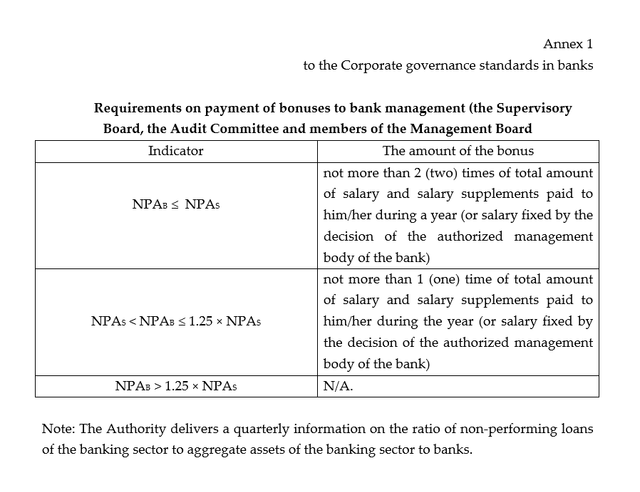
13.3. Total amount of bonuses paid to each employee provided for in Article 13.2 herein, the member of a managerial body (taking into account Annex 1 to these Standards) during the year may not exceed 2 (two) times of the total amount of salary and salary supplements paid to him/her during the year (or salary fixed by the decision of the authorized management body of the bank). No remuneration is paid to a member of the Supervisory Board, whose salary is determined as a percentage of retained earnings on the basis of a decision of the bank's authorized management body. The amount and payment of the award are established taking into account the following along with the principles set in Article 13.1. herein:
13.3.1. predefined and retained portion of the bonus should not be paid if at least 25% of capital adequacy and liquidity indicators deteriorate;
13.3.2. payment of the bonus should not have a negative effect on capital resilience in long-term.
13.4. At least the following requirements are considered in compensating for bank management under sub item 13.2.1:
13.4.1. a decision on remuneration is taken once a year. At that a bank should generate net profit according to results of the fiscal year, minimum amount of bank’s aggregate capital, capital adequacy ratio and loan provisioning should be in line with results of the fiscal year and prudential norms set by the Authority as at the date of the decision on remuneration;
13.4.2. payment of remuneration to the management specified in sub-item 13.2.1 herein in terms of both final results of the financial year and the ratio of non-performing assets to total assets of the bank (NPAB) and the ratio of non-performing assets of the banking sector to total assets of the banking sector (NPAS) as at the date of the remuneration decision is made in light of the requirements of Annex 1 herein;
13.4.3. except for the remuneration paid with bank shares, payment of 50 (fifty) percent of the bonus is deferred and paid in installments within upcoming three years;
13.4.4. if a bank is in loss according to results of any following fiscal year, or the bank violates prudential norms set by the Authority on the minimum amount of aggregate capital, calculated capital adequacy ratio or loan loss provisioning or, except for the cases when the general meeting of shareholders decides to decrease the bank’s profit target, earned net profit falls below 25 (twenty five) percent of the net profit of the year the bonus is calculated, as well as the NPAB exceeds 125% of the NPAS, the deferred and designated for the year remuneration is not paid. If these cases are eliminated upcoming financial year(s) the portion of deferred remuneration meant for the year is paid;
13.4.5. if interest is to be accrued on the deferred portion of the bonus, interest payments should not exceed the interest rate ceiling set by the Deposits Insurance Fund for protected deposits as at the date of the decision on payment of bonus;
13.4.6. the portion of the bonus deferred in any form is not taken as securitization on liabilities due to he bank;
13.4.7. if persons related to bank management are discharged or dismissed from employment, the deferred portion of the bonus is paid under sub items 13.4.2 – 13.4.6 herein.
13.5. All conditions specified in Item 13.4 herein on bonuses paid to persons in bank management are included to the decision of the authorized managerial body on remuneration.
13.6. The size of the bonus to be paid to the bank employees as per sub item 13.2.2. herein should not depend on the activity of the structural unit to be examined, as well as not compromise independence of employees.
13.7. bank employees and members of managerial bodies specified in sub items 13.2.1, 13.2.2 and 13.2.4 herein, are not paid the bonus, including its deferred portion, in the following instances:
13.7.1. until the bank, that obtained a loan from the Central Bank as a lender of last resort, meets liabilities in full;
13.7.2. if the Authority issues a mandatory instruction to the bank to create special reserves, raise capital or eliminate violations of the capital adequacy ratio, until the instruction in question is implemented by the bank in full;
13.7.3. if the Authority imposes sanctions on dismissal from position according to the ‘Regulations on review of materials regarding dismissal of bank administrators from their positions and imposing sanctions on revocation of banking’ (with respect to persons specified in sub item 13.2.1. herein).
13.8. A decision on granting bonuses to bank’s managers per year (except for deferred bonuses) and their sizes are approved by the General Meeting of Shareholders, while a decision on remuneration of bank employees under other categories are approved by the Supervisory Board. A copy of the decision on remuneration is delivered to the Authority within 30 (thirty) days after the decision is taken.
13.9. The bank delivers a report on bonuses to persons specified in Item 13.2. herein over the year and based upon annual results (the size of bonus per person) to the Authority until June 7 of every upcoming year.
13.10. The bank pays dividends by informing the Authority at the latest within 5 (five) business days from the date a relevant decision is taken.
14. Requirements on remuneration in local branches of foreign banks
14.1. The size of remuneration to each employee, including managers of a local branch of a foreign bank over a year should not exceed 2 (two) times of the salary and supplements to compensation paid to him/her over a year.
14.2. Branch managers (head of a branch and his/her deputy, as well as the employee, responsible for controlling one or a number of structural units) are remunerated in line with the requirements specified in sub item 13.4 herein.
14.3. No bonuses are paid in a branch in the cases specified in Item 13.7. herein.
15. Financial management and reporting
15.1. The financial management and reporting system is a part of the bank’s internal control system. Bank’s CFO should establish the accounting policy to cover the system’s key elements – financial management and reporting methods, internal procedures, as well as reports to the management and financial control mechanisms.
15.2. Duties on financial management and reporting are divided as follows:
15.2.1. general meeting of shareholders or, if authorized, the Supervisory Board, approves and, if required, provides revision of the bank’s accounting policy;
15.2.2. the Supervisory Board oversees proper and timely implementation of methods and internal procedures, established in the bank’s accounting policy;
15.2.3. annual financial statements are approved by the general meeting of shareholders. The Supervisory Board ensures timely delivery of financial statements to data users, while the Audit Committee ensures their reliability and transparency;
15.2.4. the Management Board creates a financial planning system and analyzes the status of the annual budget;
15.2.5. The CFO ensures proper organization of the operation of structural units, that discharge accounting, reporting and financial control functions;
15.2.6. in compliance with bank’s internal procedures, heads of structural units develop and submit data to ensure financial control.
15.3. Bank’s all operations should be recorded in the bank’s general ledger, and its administration and usage regulations established. At that, members of the Supervisory Board, the Audit Committee and the Management Board, head of the Risk Management Division, the CFO, the chef accountant (head of financial service) and, under the regulations on the system usage, other administrators and employees should be capable to log in to the system.
15.4. Where operations of branches and departments are recorded in the bank’s general ledger in an online regime, the position of a chief accountant to this branch and department is not required.
15.5. Bank’s annual budget is developed under the leadership of the bank’s CFO at least 45 days prior to the beginning of the next calendar year, coordinated with the Management Board, and approved by the General Meeting of Shareholders or, if authorized, by the Supervisory Board, prior to the beginning of the budget year.
16. Data disclosure
16.1. Financial statements, that reflect bank’s performance and financial standing, are developed separately and on a consolidated basis in accordance with the IFRS, while annual financial statements are approved by an external auditor and disclosed jointly with the auditor opinion within the period, specified in Article 45 of the Law of the Republic of Azerbaijan on Banks. The annual financial report and consolidated financial statements are published on the bank’s website and mass media together with an auditor opinion as per the legislation.
16.2. The bank places quarterly prudential data established in Annex 2 herein and information on the risks the bank faces on the bank’s website.
16.3. Every bank should provide users with the following group of information it publishes annually to take economic decisions, evaluate bank’s financial standing and efficiently compare various banks when taking decisions:
16.3.1. general information on the bank and its activities;
16.3.2. information on the structure and adequacy of the bank capital.
16.4. Data should be in harmony with the principles of reliability, comprehensibility, promptness, significance, actuality, comparability, when disclosed, and balance between transparency and protection of commercial interests.
16.5. The order and periodicity of data disclosure, composition and order of delivery to users, as well as the mechanism of coverage of these processes with internal control are established with internal regulations approved by the Supervisory Board given the requirements herein.
16.6. General information, disclosed on the bank and its performance, includes:
16.6.1. financial indicators on the reporting period;
16.6.2. related party transactions and transactions of special importance (specifying the parties to and the amount of the transaction;
16.6.3. attracted funds;
16.6.4. managerial bodies and officials, their main and additional work places, phone numbers, email, information on their education and qualification;
16.6.5. managerial structure;
16.6.6. development policy (strategic mission and mission statement, strategic targets);
16.6.7. return on share capital and the dividend policy
16.6.8. total amount of payments per member of the managerial body (1st, last and middle names, position and payment amount);
16.6.9. size and source of investments;
16.6.10. turnover and yield on securities of the company (including the type, form, state registration number, nominal cost of investment securities, rights of owners, maturity);
16.6.11. public projects.
16.6.12. if any, information on bank ratings (the name of rating agency, the date of the rating, bank’s current and previous rating);
16.6.13. internal committees of the bank, their main duties and composition;
16.6.14. information on significant changes in bank’s management and organizational structure;
16.6.15. main principles of the remuneration policy;
16.6.16. information on the external auditor, that audited bank’s recent fiscal year;
16.6.17. information on bank branches/divisions (name, address, type of activities, date of opening and contact requisites);
16.6.18. information on bank subsidiaries (name, activity directions);
16.6.19. information on shareholders, with relevant participation share in bank capital and their participation share, obtained under the requirements of the legislation on securities.
16.7. Data, disclosed on the structure and adequacy of the bank capital include:
16.7.1. amount of aggregate capital;
16.7.2. amount and its components Tier I and II capital;
16.7.3. deductions from bank’s aggregate capital;
16.7.4. value of assets weighted per risk degree;
16.7.5. adequacy of aggregate and Tier I capital, as well as bank’s actual indicators, compared to the requirements set in regulations of the Authority on leverage ratios.
16.8. Information, disclosed on management of significant risks, the bank is exposed to, includes:
16.8.1. bank’s risk management policy;
16.8.2. amount and share of overdue loans in the lending portfolio;
16.8.3. total substandard loans, their amount and share in the lending portfolio per sub-category;
16.8.4. amount of and ratio of general and special reserves to the lending portfolio;
16.8.5. total off-balance sheet liabilities and their amount per type;
16.8.6. regional geographic segregation of loans, including overdue loans;
16.8.7. regional economic segregation of loans, including overdue loans;
16.8.8. amount and ratio of large loans to aggregate capital;
16.8.9. classification on sensitivity to the interest rate risk;
16.8.10. classification of assets and liabilities with fixed and flexible interest rates;
16.8.11. bank’s separate and aggregate open currency position per key currency, indicating key foreign currency, used in operations and prudential norms on the open currency position;
16.8.12. a list, and brief explanation of instruments (hedge instruments) used to prevent foreign currency risks;
16.8.13. maturity breakdown of assets and liabilities per currency (national and foreign).
16.9. Every bank may disclose other data on its performance, it finds important other than the data protected by the law.
16.10. Disclosed data are placed on the bank’s website. Bank’s financial statements should be maintained on the bank’s website within three years upon the date of placement, while other data – at least within six months. Disclosed data should be accompanied with the date, they are placed on the website. Those data may be additionally placed on other mass media. Those data should be directly delivered to data users based upon their inquiries without any charges.
16.11. Financial statements and other disclosed data should be signed by the Chairman of the Management Board and the chief accountant (head of the financial service).
16.12. A notice on disclosed data is placed in administrative buildings of every bank, including branches and departments on a visible place. The notice includes information on the person, designated to respond to inquiries, related to disclosed data (his/her 1st and last names, phone number, e-mail address).
16.13. The information is disclosed in the following periods:
16.13.1. general information on the bank and its performance, as well as risks it is exposed to – no less than once a year; in case of key changes to these data – no less than once a half year;
16.13.2. information on the structure and adequacy of the bank capital – no less than once a quarter, within the first month of the next quarter.
17. Rules of ethical conduct
17.1. Every bank establishes ethical conduct rules in relation to its staff. The document should at least address employee’s conduct during and after business hours, avoidance of corruption, prevention of legalization of criminally obtained funds and other property and financing of terrorism, employment with other institutions and maintenance of managerial positions, attitude to the bank property, protection from repressive measures for providing confidential information to the bank's management, as well as protection of confidentiality and the rule of law.
17.2. Banks should be guided by the code of ethical conduct when reviewing customer appeals.
17.3. Structural units of banks, engaged in regulation of relations with consumers, protection of their rights, review of and response to their appeals, should ensure proper discharge of their functions and that their employees have necessary knowledge and experience.
18. Corporate governance in bank holding companies
18.1. Corporate governance standards in subsidiary bank(s) are established in line with the performance and risks of those bank(s) and bank holding companies.
18.2. The Supervisory Board of the bank holding company should be aware of all risks the bank holding company and its subsidiary bank(s) may face and likely to affect its performance. At that, activity of the Supervisory Board of the bank holding company should not compromise independence of the Supervisory Board of its subsidiary bank(s).
18.3. The Supervisory Board of subsidiary bank(s) exercise the rights and discharge the duties specified in Section 7 herein within the frames of the risk appetite set by the bank holding company.
18.4. The subsidiary bank applies corporate governance standards set by the bank holding company without contradicting the corporate governance standards established by the banking regulatory authorities of the host country.