
 966
966




“Approved”
Central Bank of
the Republic of Azerbaijan
Resolution № 04/2
“4” February 2022
Regulations on opening, maintaining and closing bank accounts
1. General provisions
1.1. These Regulations have been developed according to the Civil Code of the Republic of Azerbaijan and other normative acts of legal nature on the basis of Article 36.2 of the ‘Law of the Republic of Azerbaijan on Banks’ and determine procedures for opening, maintaining and closing bank accounts in banks and local branches of foreign banks operating in the Republic of Azerbaijan (hereinafter – the bank).
1.2. These Regulations do not apply to opening foreign currency accounts by residents outside the Republic of Azerbaijan, as well as the procedure on maintaining foreign currency operations by residents and national and foreign currency operations of non-residents.
1.3. The procedure for opening, maintaining and suspending special election accounts is determined by the Central Election Committee of the Republic of Azerbaijan.
1.4. Banks open correspondent accounts in the national currency domestically only with the Central Bank of the Republic of Azerbaijan (hereinafter – the Central Bank).
1.5. According to the requirement of the ‘Law of the Republic of Azerbaijan on Budget system’, a written permit of the State Treasury Agency under the Ministry of Finance of the Republic of Azerbaijan is required for opening bank accounts for budget organizations (organizations directly financed from the state budget and the budget of the Nakhchivan Autonomous Republic).
1.6. According to the Laws of the Republic of Azerbaijan ‘on Grant’ and ‘on Non-governmental organizations (public unions and funds)’, bank operations related to grant agreements on residents’ bank accounts in the national currency, and to donations accepted by non-governmental organizations are maintained only upon submission of a document confirming the registration of the agreement (decision) on granting or receiving grants or providing information on donations. Requirements for banking operations related to grant agreements (decisions) also apply to sub-grants and additional agreements on grant agreements (decisions), as well as changes to the term, purpose and amount of agreements (decisions).
1.7. The definitions ‘resident and non-resident’ used herein bear the meanings established by the ‘Law of the Republic of Azerbaijan on Currency Regulation’; ‘the beneficiary owner’, ‘public figures of foreign countries’, ‘business relations’ and ‘the internal control system’ the meanings established in the ‘Law of the Republic of Azerbaijan on Prevention of Legalization of Criminally Obtained Funds or other Property and Financing of the Terrorism’; the definition ‘qualifying holding‘ the meaning in the Law on Banks; ‘electronic signature’ and ‘strengthened electronic signature’ the meanings set in the ‘Law on Electronic Signature and Electronic Document’.
1.8. The definition ‘customer’ used herein include public authorities (institutions) and municipalities along with the meaning established in the ‘Law of the Republic of Azerbaijan on Prevention of Legalization of Criminally Obtained Funds or other Property and Financing of the Terrorism’ (hereinafter – the AML/CTF Law).
2. Types of bank accounts
2.1. Bank accounts are divided into the following types:
2.1.1. current accounts;
2.1.2. current subaccounts;
2.1.3. deposit accounts;
2.1.4. correspondent accounts.
2.2. Current accounts are opened for the following purposes:
2.2.1. maintenance of bank operations of public institutions, municipalities, legal entities, including legal entities under public law, their branches and representative offices, international organizations, diplomatic and other official representative offices, family farms, landowners who use own lands suitable for agriculture and unincorporated individuals (hereinafter – private entrepreneur), private notaries in connection with their financial and economic activities;
2.2.2. for individuals – receive and debit funds to their accounts, transfer and paying funds from their accounts, as well as execution of orders on conducting other operations on the account;
2.2.3. for primary Trade Union organizations for the purposes defined in the law and their charters.
2.3. Current sub-accounts are opened for structural units of legal entities that do not have the status of branches and representative offices and are located outside their location. Funds transferred to these accounts are transferred to the current account of the legal entity within the period specified in the bank account agreement, except for the payment of salaries and other obligatory salary transfers of the staff of those structural units, as well as utility payments providing activities of those institutions.
2.4. Current accounts include temporary and special current accounts.
2.5. Temporary current accounts are opened for legal entities for payment of their authorized, share capital, as well as property shares until state registration, as well as for maintenance of funds representing the value of investment securities in public offering.
2.6. Special current accounts are opened for the following purposes:
2.6.1. a current account of budget organizations – conduction of operations specified in the permit issued as per Item 1.5 herein;
2.6.2. deposit accounts of courts, executive authorities, customs authorities, public institutions carrying out criminal prosecution, as well as other public authorities in the cases stipulated by the legislation – for banking operations stipulated in the legislation;
2.6.3. a notary deposit account – for state and private notaries for receipt, maintaining and other operations involving funds and securities from legal entities and individuals as provided by the applicable laws;
2.6.4. guarantee cash accounts - for private notaries to collect and use funds designated by the law to guarantee the responsibility of private notaries before their customers;
2.6.5. insurance bank account - collection and use of funds provided by law to guarantee responsibility of lawyers before protected or represented persons;
2.6.6. special account of a person willing to obtain a license for foreign exchange activities - pledge and depositing of funds provided by law during the license term (these deposits cannot be used as collateral for other transactions);
2.6.7. special election account – for the purposes defined by the Election Code of the Republic of Azerbaijan.
2.7. Banks grant loans to customers only through the customer’s existing account or the current account opened for the purpose. Loans issued for an entrepreneurial activity are transferred to customers' bank accounts opened only as taxpayers.
2.8. Savings accounts are accounts opened under a bank deposit agreement to attract customers' funds to deposits and conduct relevant operations.
2.9. Correspondent accounts are accounts opened for local and foreign banks for conducting banking operations by banks themselves and their customers.
2.10. A current account is opened in the Central Bank for liquidation works, in case of voluntary liquidation of the bank at the request of the liquidation committee, within the procedure of compulsory liquidation or bankruptcy appointed at the request of the liquidator appointed by the court, funds in bank's correspondent and other accounts are transferred to that account.
3. The ‘know your customer’ principle
3.1. Banks should have internal rules in place compliant with the ‘Know Your Customer’ principle (hereinafter – internal rules) for opening, maintaining and closing bank accounts. Internal rules are developed in line with the AML/CTF Law, the present Regulation, other legal acts and the risk management system of the bank and are approved by the Supervisory Board of the bank.
3.2. Internal rules address at least the following issues:
3.2.1. procedures for identification and verification of a customer and a beneficiary owner;
3.2.2. decision-making procedures for establishing business relations with customers;
3.2.3. identification of customers’ risk levels and categorizing them according to the level of risk;
3.2.4. for continuous monitoring of customers' bank accounts and operations in accordance with the risk category;
3.2.5. management of money laundering and terrorist financing risks.
3.3. Depending on a customer’s risk category the bank monitors bank accounts and operations on an ongoing basis, and sets procedures and mechanisms that determine whether the operations are unusual and suspicious.
3.4. The bank clearly allocates authorities across all management levels to manage risks on opening, maintaining and closing bank accounts.
3.5. Internal rules may set operating limits for remote account opening and (or) remote bank account operations.
3.6. When developing internal rules the bank should be guided by provision of professional and ethical norms, avoiding conflicts of interest and illegal activities and should not restrict access to financial services unreasonably.
3.7. When a bank account is opened in the name of two or more individuals (joint account), the ‘know your customer’ principle established herein and other requirements for the customer apply to the owners of that account separately.
4. Opening, documentation of bank accounts, sample signature and stamp sheets
4.1. Guided by the ‘know your customer’ principle prior to opening a bank account, the bank obtains the initial information specified in Annex 1 herein from the person applying for account opening.
4.2. Bank accounts are opened for new customers based on the documents as per Annex 2 herein and those arising from international treaties the Republic of Azerbaijan is a party to. The bank verifies authenticity of the documents, copies the paper documents required to be kept in the bank. Documents obtained in an electronic form can be stored electronically in the bank without being transferred to paper.
4.3. Where there is integration to public information systems, the bank gets relevant documents and information for bank account opening specified in Annex 2 herein, including the documents to be notarized from those information systems.
4.4. Except for customers on whom simplified identification and verification measures are applied due to the low money laundering and terrorist financing risk, if it is determined that another customer or his/her authorized representative has any of the indications specified in Items 4.4.-4.6 herein, the customer or his/her authorized representative provides additional identification information as per Annex 3 herein in writing (confirmed with a physical signature, strengthened customer authentication or strengthened electronic signature) (this information is not required to be documented).
4.5. Prior to opening a bank account for a new customer, who is an individual or a private entrepreneur, it should be determined whether he/she or his/her authorized representative has one or more of the following indications:
4.5.1. availability of the cases specified in Article 7.2.1 of the AML/CTF Law;
4.5.2. conduction of operations specified in Article 7.2.2 of the AML/CTF Law;
4.5.3. match to the list of persons to be sanctioned specified in Article 7.3-1 of the AML/CTF Law;
4.5.4. is in the high risk category set within the bank's internal control system;
4.5.5. public figure of foreign states.
4.6. where a new authorized representative of an individual or a private entrepreneur applies for bank account opening, it is determined whether the account holder and that authorized representative has one or more of the indications as per Item 4.5 herein.
4.7. Prior to opening a bank account for a new customer legal entity (its branch of representative office) (except for legal entities 100% of shares of which are owned by the state, public legal entities, international organizations, diplomatic and other official missions) it should be identified whether it has one or some of the indications specified in Item 4.5 herein. This requirement also applies to the authorized representative who opens an account for a legal entity, beneficiary owners of the legal entity, the head (s) of the management body (s) of the legal entity and the persons authorized to dispose of the legal entity's bank accounts.
4.8. A new customer legal entity applying for a bank account is identified and verified until full assurance that its beneficiary owners that are individuals have been identified. For this, measures are taken in the following sequence:
4.8.1. individuals with qualifying holding in a legal entity are identified, if any, accuracy of the information is verified through reliable and independent sources, copied and stored;
4.8.2. if there are suspicions about individuals with qualifying holding, specified in sub-item 4.8.1 herein, being beneficiary owners of the legal entity or there are no individuals exercising control over the legal entity with the participation share in the legal entity, individuals exercising control over the legal entity on a contractual or another basis are identified, accuracy of the information is verified through reliable and independent sources, copied and stored;
4.8.3. if the persons specified in sub-items 4.8.1 and 4.8.2 herein are not identified, the individual who manages the executive body of that legal entity is identified.
4.9. A bank account is formalized by concluding a bank account agreement between the customer or his/her authorized representative and the bank on paper or electronically. The bank account agreement should be clear and legible. The bank should provide a copy of the bank account agreement concluded electronically at the request of the customer on paper free of charge.
4.10. The number of the bank account opened for the customer is determined according to the IBAN structure (International Bank Account Number) as per Annex 7 herein and delivered to the customer by the bank.
4.11. With the consent of the parties, the bank account agreement is changed or a new agreement is concluded when:
4.11.1. name and/or subordination of a public institution or municipality changes;
4.11.2. name and/or organizational /legal form of the legal entity changes;
4.11.3. name and/or subordination of the branch and representative office, or another separate unit, and (or) organizational-legal form of the legal entity it is subordinated to changes;
4.11.4. individual’s (private entrepreneur’s) first, middle or last names change.
4.12. Changes provided for in Item 4.11 herein are made on the basis of relevant confirmation (identification) documents, in this case the customer is not required to change the account number opened, as well as provide the customer with a new duplicate certificate.
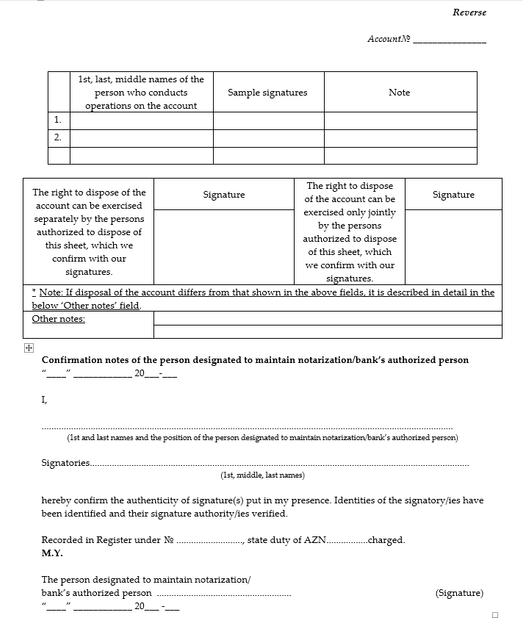
4.13. The requirements for the development of sample signature and seal (sample signature in respect to individuals and private entrepreneurs), the form of which is defined in Annex 5 herein, are as follows:
4.13.1. A sample signature and seal sheet of a public institution (body), municipality, international organization, diplomatic and other official missions, legal entity, including public legal entity, their branches and representative offices, as well as the first trade union organization are notarized or if specified by internal rules of the bank approved by the authorized person of the bank (the right to dispose of the bank account is exercised by heads of those organizations and (or) authorized persons, and if the right to dispose of the bank account belongs to one person, it is noted on the sheet);
4.13.2. A sample signature sheet of an individual, private entrepreneur, private notary, family farm, landowner using agricultural land, as well as an authorized person of a legal entity opening a temporary current account are approved by the bank's authorized person (except for a private notary, in case of doubt about legal entity’s reliability and ability, the bank requires notarization of the signature sheet);
4.13.3. If the signature and stamp sample sheet implies signatures of two or more persons entitled to sign, the order of use of signatures is indicated on that sheet (when signatures are formalized as the first and second signature rights, the account can be disposed of if at least one of the persons entitled to the first and second signatures sign);
4.13.4. The sheet includes an image of the customer’s stamp and at that, seals and stamps like ‘for staff’, ‘for entry’, ‘for references’ and similar purposes may not be used;
4.13.5. If the customer does not have a stamp, a relevant note is made on the sheet. In case of temporary absence of the stamp (change in the name, subordination of the customer, loss or obsolescence of the stamp), the order of formalization of bank documents is determined by a written agreement between the bank and the customer;
4.13.6. When a customer, who is an individual, private entrepreneur, family farm or a landowner using agricultural land owned by him/her delegates the right to dispose of the bank account to another person too, a note is made on the sheet whether they will exercise this right separately, or jointly;
4.13.7. When opening a joint account in accordance with Item 3.7 herein, a note is made on the signature sample sheet reflecting the procedure for exercising the right of joint account holders to dispose of the account;
4.13.8. if the customer delegates the right to dispose of the account to another person over the lifetime of the account, signatures of those persons are certified by the bank on the signature sheet based on a notarized power of attorney or the customer’s application.
4.14. A new signature and stamp sample sheet is delivered, if the persons with the right to sign in the signature and stamp sample sheet change or the number of persons with the right to sign increases (decreases), or the stamp in the sheet changes, a new signature and stamp sample sheet is delivered. In this case, the invalid sheet is kept in the bank account file.
4.15. If it is not possible to replace the signature and seal sample sheets with new ones in case of partial replacement or increase in the number of persons entitled to sign, signatures of the persons entitled to dispose of the account may be confirmed on additional signature and seal sample sheets, provided that relevant note is made on the sheet in accordance with the requirements of sub-item 4.13.3. herein.
4.16. If it is not possible to develop a new signature and seal sample sheet when the number of persons entitled to sign on the sample signature and seal sample sheet decreases, the authorized person of the account holder applies to the bank in writing and the bank’s authorized person makes relevant notes on the signature and seal sample sheet. If the validity of the application creates suspicions, the bank requires the account holder to submit a new notarized signature and stamp sample sheet.
4.17. Sample of signatures and seals of customers are approved by the bank’s authorized person. In this case, the identity of the signatories is determined, their authority and authenticity of their signatures are checked. The authenticity of the signature is confirmed by the personal presence of the signature holder (s). In this case, a sample sheet of signatures and seals is drawn up in the number specified by the bank
4.18. Sample notarized signature and seal sheets are submitted to the bank in two copies.
4.19. When required for operations, copies of the signature and stamp sample sheets are submitted to the operating units electronically with the approval of the bank's authorized person in accordance with Item 4.17 herein and placed on paper or in the bank's automated operating system.
4.20. In the cases provided for in Item 4.11 herein, the signature and seal sample sheets are changed accordingly or a new signature and seal sample sheet is submitted. In this case, if the customer's seal changes, a new signature and seal sample sheet is drawn up in accordance with Item 4.14 herein.
4.21. When the right to open a bank account and dispose of the account is given to the authorized representative on the basis of a power of attorney, the signature of the authorized representative is confirmed on the sample signature sheet, and confirmation of the signature holder's sample signature is required when he/she disposes of the account.
4.22. When opening a remote bank account in accordance with Part 5 herein, a sample signature and stamp sheet is not required. If a customer who has opened a bank account remotely orders to carry out operations on that bank account on paper, a sample sheet of signature and seal should be submitted in accordance with the requirements herein.
5. Remote account opening
5.1. The bank may open a bank account remotely in accordance with the requirements herein. Opening a bank account remotely involves opening a bank account without the joint physical presence of the customer and the bank employee by the means provided for in Item 5.10 herein.
5.2. Customers are not allowed to open a bank account through an authorized representative (except for a legal representative of a legal entity), as well as non-resident legal entities remotely.
5.3. Remote bank account can be opened only if the bank obtains all the documents required by these Regulations from public information systems.
5.4. When the bank sets limits on remote bank accounts in accordance with Item 3.5 herein, these limits should be observed when opening an account
5.5. Remote bank account opening for a new customer, as well as registration of documents on account opening is carried out as follows:
5.5.1. with strengthened electronic signatures and video calls for resident legal entities and private entrepreneurs, as well as non-resident individuals;
5.5.2. with strengthened electronic signatures and video calls or with strengthened customer authentication and video calls for resident individuals.
5.6. Opening of new bank accounts remotely by customers who have accounts with that bank, including formalization of documents regarding the opening of an account can be maintained for resident legal entities and private entrepreneurs, as well as non-resident individuals by strengthened e-signature and video recording; and for resident individuals by strengthened e-signature or strengthened customer authentication and video recording. In this case, the bank may apply a video call if it considers the video recording method risky.
5.7. Strengthened customer authentication is defined as the authentication, developed to protect confidentiality of authentication information, that is based upon the use of two or more independent elements ‘known’ to only (password, pin code, set of questions etc.), ‘owned’ by (mobile phone application, OTP, TOTP, e-signature, token, etc.) or ‘belonging’ to (face, voice recognition, fingerprint etc.) to the customer or the individual who wants to become a customer (perfect identification of a person). The independence of the elements means that the capture of one element does not endanger the security of another element.
5.8. Requirements for video identification (video call and video recording) for opening bank accounts remotely are regulated by Annex 6 herein.
5.9. To open a remote bank account, the requirements of these Regulations should be observed, and the documents specified in Part 4 herein be obtained
5.10. Remote bank account opening is carried out through the information system operated by the bank or the Central Bank or their mobile application.
5.11 All terms of the remote bank account agreement are provided to the customer in a form that can be read by the customer through the relevant Internet resource or mobile application, and the customer's consent to the text is provided. The bank account agreement concluded remotely is confirmed by the bank with a strengthened e-signature.
5.12. The Bank ensures that the remotely concluded bank account agreement is submitted to the customer on paper or other durable medium (any means that allows the information to be stored for a period in accordance with its purposes and the stored information can be reflected without change).
5.13. The written conclusion and signature requirement of the bank account agreement and other documents required for opening the account by the individual are considered fulfilled by confirming the agreement in writing by means of strengthened customer authentication.
6. Ongoing control over bank accounts and operations on accounts
6.1. Reliability of documents and information provided by the customer or his/her authorized person, their compliance with the nature of transactions through bank accounts, as well as customer’s or his/her authorized person’s matching the indications as per Items 4.5-4.7 herein is monitored depending on customer’s risk category under the periodicity set by the bank, but no less than once a year.
6.2. If the monitoring discovers mismatches specified in Item 6.1, within 5 (five) business days the customer or his/her authorized representative is required to provide information explaining its reasons or the documents confirming it, and the information specified in Annex 3 herein in writing (physical signature, strengthened customer authentication or confirmed with electronic signature) within 30 (thirty) calendar days.
6.3. The bank checks reliability of documents and information provided by the customer (respondent bank) to which supplies banking services, their compliance with the essence of transactions through bank accounts at intervals determined by the bank's internal rules, but no less than once a year, depending on the customer's risk category, whether there is incompliance, re-obtains the documents and information provided for in Items 8.3-8.4 herein.
6.4. The bank takes measures regarding unusual, suspicious accounts with no obvious economic or legal purpose it reveals within the frames of ongoing monitoring in accordance with the AML/CTF Law.
7. Rejection to open bank accounts, suspension of operations, freezing of funds in bank accounts and closing of bank accounts
7.1. Account opening is rejected in the following cases:
7.1.1. when documents required for account opening are not submitted in full, the submitted documents or information contain inaccurate, distorted or contradictory information;
7.1.2. when identification information on the customer, his/her authorized representative or beneficiary owner is in the list specified in Article 7.3-1 of the AML/CTF Law;
7.1.3. in the cases as per Article 956.3 of the Civil Code of the Republic of Azerbaijan.
7.2. In case of refusal to open a bank account, the bank, at the request of the customer or his authorized representative, informs them in writing (electronically or on paper) about the reasons for refusing to open an account, except as provided by law. In case of refusal to open a bank account, the information obtained by the bank may be stored in the bank.
7.3. Termination of the bank account agreement is the basis for closing the customer account. The bank closes customer’s account in the following cases:
7.3.1. at the request of a customer or his/her authorized representative;
7.3.2. if the State Treasury Agency under the Ministry of Finance of the Republic of Azerbaijan revokes the permit for opening a bank account for budget organizations;
7.3.3. if the requirements of Item 6.2. are violated;
7.3.4. if the requirements on identification and verification of the customer and beneficiary owners cannot be met, there are suspicions on accuracy of the information previously delivered on the customer and beneficiary owner, as well as it is impossible to obtain information on the nature and purpose of customer’s business relations;
7.3.5. in other cases specified in the bank account agreement.
7.4. Bank accounts are closed by a court decision in the cases specified in Article 969 of the Civil Code of the Republic of Azerbaijan, except for the cases provided for in Item 7.3 herein, unless otherwise provided by the bank account agreement.
7.5. When a bank account agreement is terminated, a legal regime of the balance of funds in the account is regulated with the Civil Code of the Republic of Azerbaijan. If the customer does not withdraw the balance of funds in the account or the bank is not informed about the new account, the funds should be transferred to, the funds are transferred to the account where closed accounts of the relevant customer category are accounted for and the customer is notified accordingly in writing (electronically or on a paper carrier).
7.6. The legal regime of the balance of funds in bank accounts of died or missing individuals is regulated by the Civil Code of the Republic of Azerbaijan.
7.7. When a bank account opened on a certificate-duplicate is closed, related information is sent to a tax authority within 3 (three) work days.
7.8. When bank account is closed, all documents related to documentation of the account are kept at the bank within the period specified in the legislation.
7.9. Accounts of banks are closed in the following cases:
7.9.1. at the request of the bank;
7.9.2. a banking license is revoked, upon written appeal of the Central Bank.
7.10. Restrictions on issuance of orders to customers' bank accounts, as well as suspension, freezing of account operations and the notification of customers in this regard are regulated by law.
8. Opening and closing correspondent accounts of foreign banks with local banks
8.1. Opening, maintaining and closing of correspondent accounts of foreign banks with local banks is addressed in internal rules in line with the KYC principle.
8.2. A local bank obtains documents specified in Annex 4 herein and validates the obtained documents, including information through reliable sources (sending inquiries to banking supervision authority or official publications and other information whose source is known).
8.3. Prior to opening correspondent accounts for foreign banks local banks assess risks at least by obtaining the following information and takes measures on risk management:
8.3.1. the purpose of banking services to be provided for foreign banks;
8.3.2. use of a correspondent account opened with a correspondent bank (the bank that opens a correspondent account in favor of a respondent bank) by respondent banks of a respondent bank (the bank in whose favor a correspondent account is opened);
8.3.3. allowing an individual or a legal entity, that is the respondent bank’s customer to directly use the correspondent account opened with the correspondent bank;
8.3.4. foreign bank’s main activities, the types of services it offers to its customers and customer categories (legal entities, individuals etc.);
8.3.5. the types and the number of operations conducted by the foreign bank within the timeframe required by the local bank ( at least recent one year; when operating for less than a year, the period covering the activity);
8.3.6. foreign bank’s managerial bodies, organizational structure, beneficiary owners;
8.3.7. identification of foreign bank’s money laundering and terrorist financing risks and availability of internal control, policies and procedures for their prevention, including the measures applied by the respondent bank to know its customers;
8.3.8. investigative actions, prosecution against the healthy reputation of a foreign bank, and the foreign bank or its official for violations related to money laundering and terrorist financing by a competent authority or imposing sanctions by a supervisory authority;
8.3.9. foreign bank’s home country;
8.3.10. the country where foreign bank’s subsidiaries and branches, as well as third parties which will use correspondent banking services are located;
8.3.11. regulation and supervision in the foreign bank’s country (where a respondent bank is a part of a holding company, the country of registration of the holding company) (legal framework on AML/CTF).
8.4. If it is known that the correspondent account opened with the correspondent bank is used by respondent banks of the respondent bank, the correspondent bank also obtains the following information to evaluate the risk of the respondent bank that opens a correspondent account:
8.4.1. the number and type of financial institutions the respondent bank serves;
8.4.2. whether respondent bank and its respondent banks are located in different countries and are covered with public supervision in that country (those countries);
8.4.3. types of banking services the respondent bank renders to other respondent banks from the correspondent account;
8.4.4. duration of correspondent banking relations between the respondent bank’s respondent banks.
8.5. If the respondent bank's correspondent account is intended to be used directly by third parties (payable-through account), the correspondent bank should identify and verify these persons, as well as make sure that the respondent bank has taken such measures and that the relevant information will be provided to it at the request of the correspondent bank (by including a relevant condition in the correspondent bank account agreement between correspondent and the respondent banks or with another supporting document establishing such assurance).
8.6. The decision to establish and terminate a correspondent banking relationship is made by the competent management body of the correspondent bank.
8.7. Opening of correspondent accounts is refused when:
8.7.1. documents specified in Annex 4 herein for account opening are provided not in full;
8.7.2. there is inaccurate, distorted or contradictory information in the documents submitted or information provided for account opening;
8.7.3. it is impossible to take measures for the management of risks related to establishment of correspondent banking relations, and execute Item 8.5 herein;
8.7.4. the respondent bank is a state registered bank without physical presence in any state or territory, has a banking license, but cannot be covered by regulatory and supervisory processes by banking regulation and supervisory authorities, including when it is identified that the correspondent bank will be used by the bank with the above characteristics.
8.8. The bank closes customer’s correspondent accounts in the following cases:
8.8.1. at foreign bank’s request;
8.8.2. when documents submitted for opening a correspondent account are considered invalid, as well as information is received from the relevant body regarding the invalidity of those documents;
8.8.3. when foreign bank’s banking license is revoked;
8.8.4. when it is impossible to take adequate risk-based measures against money laundering and terrorist financing, and execute Item 8.5 herein;
8.8.5. in other cases specified in the correspondent account agreement.
8.9. The requirements set forth herein for correspondent banking relations in relation to respondent foreign banks also apply to other foreign financial institutions willing to open accounts in local banks for conducting customer operations.
Annex 1 to the Regulations on opening, maintaining and closing bank accounts
Initial information obtained prior to bank account opening
1. Deadline for provision of information by a customer:
INDIVIDUALS:
2. Customer’s 1st, last, middle names, date and place of birth;
3. Gender;
4. Citizenship;
5. PIN, if not available, series and number of the ID card, if not available, other personal identification information of the ID card;
6. Registration and residential addresses;
7. Resident or non-resident;
8. Landline of mobile phone number, e-mail;
9. Place and address f employment (involved in entrepreneurship), position;
10. TIN (if engaged in entrepreneurship);
11. Information to identify the indications as per Items 4.5 and 4.6 herein;
12. Goal of probable bank account operations.
LEGAL ENTITIES:
13. Legal entity name, organizational-legal form;
14. Legal entity’s legal address and the address where the main activity is actually carried out;
15. TIN;
16. Beneficiary owners;
17. 1st, last, middle names, PIN, series and number of the ID card or other personal identification information of the persons who will (have) the right to dispose of the bank account;
18. Landline of mobile phone number, e-mail;
19. Information on officials (persons authorized to decide on current or permanent relations of a legal entity);
20. Purpose and essence of activity, main activity areas;
21. Amount of authorized capital (in manat equivalent);
22. Total staff number, and the number of branches, divisions and representative offices;
23. Information to identify the indications as per Item 4.7 herein;
24. The purpose of probable bank account transactions.
Annex 2 to the Regulations on opening, maintaining and closing bank accounts
Documents and information required for bank account opening
1. The following documents are required from public institutions, municipalities, legal entities, including public legal entities and individuals engaged in entrepreneurial activity for opening accounts:
1.1. a text of the legal act included to the State Register of Legal Acts of the Republic of Azerbaijan on approval of charters of municipalities;
1.2. a notarized copy of the charter of the legal entity;
1.3. a copy of a legal act approving the charter (statute) of the related public authority and a public legal entity operating on the basis of the charter (statute) approved by the act of the relevant public authority;
1.4. a notarized copy of the excerpt from the state register of legal entities (with the latest changes);
1.5. ID card information of an individual entrepreneur;
1.6. certificate duplicate issued by a tax authority for commercial and non-commercial legal entities, as well as individual entrepreneurs;
1.7. a signature and stamp sample sheet.
2. The following documents are required for current account opening for branches and representative offices of legal entities:
2.1. a notarized copy of the extract from the state register of legal entities (with the latest changes);
2.2. a notarized copy of the statute of the branch, representative office approved by the legal entity (for institutions operating on the basis of a model statute, a document confirming that the statute is model, is required);
2.3. certificate duplicate issued by a tax authority;
2.4. a signature and stamp sample sheet.
3. Documents and information as per Item 2.2 Annex 1 herein are obtained for current account opening for individuals.
4. The following documents are required for current account opening for the primary organization of the trade union:
4.1. A decision and an excerpt from the decision on establishment of the primary organization of the trade union of which it is a member;
4.2. a notarized copy of the charter of the trade union of which it is a member;
4.3. a signature and stamp sample sheet;
4.4. certificate duplicate issued by a tax authority.
5. The following documents are required for current account opening for family farms:
5.1. a notarized copy of the certificate issued by the municipality by which it is registered in the relevant area;
5.2. ID card information on the head of the family farm;
5.3. certificate duplicate issued by a tax authority;
5.4. a signature sample sheet.
6. The following documents are required for landowners using their land suitable for agriculture to open a current account:
6.1. ID card of the owner;
6.2. certificate duplicate issued by a tax authority;
6.3. a signature sample sheet.
7. The following documents are required for temporary current account opening:
7.1. a document confirming the identity of the founder, when an account is opened for legal entities for the purpose of payment of their charter and share capital, as well as property before their state registration;
7.2. when an account is opened for legal entities for the purpose of payment of their charter and share capital, as well as property before their state registration and a person authorized by the founder(s) for the account opening, a notarized power of attorney given to him/her by the founder(s) and a document confirming his/her identity;
7.3. a signature sample sheet/ a signature and stamp sample sheet;
7.4. copies of an excerpt from the state register of securities and a written notice of approval of the issue prospectus when opening a temporary account for storage of funds expressing their value during public offering of investment securities (in the cases specified in the Law of the Republic of Azerbaijan on the Securities Market).
8. The following documents are required for savings (deposit) account opening:
8.1. the documents specified in Items 1 and 2, Annex 1 herein for public authorities, municipalities, private entrepreneurs, legal entities, including legal entities under public law, their branches and representative offices, as well as for a public authority to place available funds of the single treasury account in accordance with the Law of the Republic of Azerbaijan on Budget System;
8.2. for individuals:
8.2.1. ID card information (the documents as per items 4, 5 and 6, Note 2, Annex 1 herein, are presented, copied to be kept in the bank and returned);
8.2.2. a signature sample sheet.
8.3. for family farms – documents in Item 5, Annex 1 herein;
8.4. for landowners who use their land suitable for agriculture – documents in Item 6, Annex 1 herein.
9. The following documents are required to open a deposit account in favor of third parties:
9.1. information allowing to identify the person in whose favor the account is opened (for a legal entity – its name and an excerpt from the state register; for an individual –1st, middle and last names, ID card information (the documents as per items 4, 5 and 6, Note 2, Annex 1 herein, are delivered, copied to be kept in the bank and returned);
9.2. if the account is opened by an individual, ID card (the documents as per items 4, 5 and 6, Note 2, Annex 1 herein, are delivered, copied to be kept in the bank and returned);
9.3. if the account is opened by a legal entity, notarized copies of the charter and the excerpt from the state register of legal entities (with the latest changes);
9.4. When a person in whose favor deposit account is opened expresses his/her intention to use the rights of a depositor, the documents specified herein for savings (deposit) account opening are required in respect to that person;
9.5. If an account opener uses the account he/she has opened for him/herself in line with the Civil Code of the Republic of Azerbaijan, in respect to that individual the documents specified herein for savings (deposit) account opening; for a legal entity a signature and stamp sample sheet and the documents specified in Item 1.6, Annex 1 herein are required.
10. The following documents are required for current sub-account opening:
10.1. a notarized copy of the extract from the state register of legal entities (with the latest changes);
10.2. certificate-duplicate issued by tax authorities for the legal entity. If a local body is a taxpayer, its certificate-duplicate;
10.3. a signature and stamp sample sheet.
11. When opening accounts for banks and other credit institutions, in addition to the documents as per Item 1, Annex 1 herein, also a written notice issued by the Central Bank with respect to appointment of administrator(s) by banks entitled to dispose of the account is delivered.
12. When various type and currency bank accounts of a customer that is a legal entity and a private entrepreneur are opened with the same bank, a certificate-duplicate issued by the tax authority is required for the new account. If the right to dispose of the newly opened account is delegated to other persons, a signature and stamp sample sheet is required on the new account.
13. To open special current accounts for budget organizations the documents in Item 1, Annex 1 herein and a letter of permit of the State Treasury Agency of the Ministry of Finance of the Republic of Azerbaijan are required.
14. The following documents are required for opening current and guarantee cash accounts for special notaries:
14.1. a notarized copy of the special notary's registration sheet;
14.2. a signature and stamp sample sheet.
15. The following documents are required for insurance account opening:
15.1. a notarized copy of the charter of the Bar Association;
15.2. a signature and stamp sample sheet.
16. The following documents are required for opening deposit accounts for public and special notaries:
16.1. a letter of consent for establishment of the notary's account with the bank from the relevant structure of the Ministry of Justice of the Republic of Azerbaijan responsible for regulation of notaries;
16.2. a notarized copy of the special notary's registration sheet;
16.3. a signature and stamp sample sheet.
17. The following documents are required for opening a special account for the person who wants to get a currency exchange license:
17.1. the documents required for deposit account opening herein if an account opener is a resident legal entity and a branch of a non-resident legal entity, as well as individual entrepreneur.
18. The documents specified in relevant parts of the present Annex are required for foreign currency denominated account opening for resident persons.
19. The following documents are required for non-residents to open national or foreign currency denominated accounts:
19.1. when an account is opened for branches and representative offices of foreign legal entities, a notarized copy of an excerpt from the state register of branches and representative offices of foreign legal entities (with the most recent changes);
19.2. when an account is opened for branches and representative offices of foreign legal entities, a notarized copy of the statute of branches of representative offices of legal entities approved as per the legislation;
19.3. individual’s ID card information;
19.4. if not otherwise specified in international treaties seconded by the Republic of Azerbaijan, copies of founding and registration documents of a non-resident legal entity legalized under the legislation and notarized translation into Azerbaijani (when an account is opened for a foreign legal entity);
19.5. certificate-duplicate issued by a tax authority (for accounts opened for entrepreneurship);
19.6. a signature and stamp sample sheet;
19.7. If provided for in international treaties seconded by the Republic of Azerbaijan, a special permit of relevant public authorities of foreign countries (financial markets supervisory authority or another public institution) for account opening (as per Item 19.4 herein);
19.8. The following documents are required to open bank accounts for international organizations, diplomatic missions and other official representative offices:
19.8.1. a document confirming the status of the international organization, the diplomatic mission and another official representative office (notarized translation in the Azerbaijani language);
19.8.2. a signature and stamp sample sheet.
20. The following documents are delivered to the Central Bank to open a current account for a liquidated bank:
20.1. application (the application provided by the liquidation committee on behalf of the liquidator is signed by the persons entitled to dispose of the current account);
20.2. in case of a voluntary liquidation of the bank, a decision of the general meeting of shareholders on the liquidation of the bank and the establishment of the liquidation committee (the decision should include the persons entitled to dispose of the account);
20.3. a court decision on forced liquidation of the bank or announcing the bank bankrupt, as well as the appointment of the liquidator;
20.4. a signature and stamp sample sheet.
Note 1:
1. An excerpt from the state register of legal entities to commercial legal entities, public legal entities, branches and representative offices of foreign commercial legal entities is given by the State Tax Service under the Ministry of Economy of the Republic of Azerbaijan, to non-commercial legal entities by the Ministry of Justice of the Republic of Azerbaijan and to religious associations by the State Committee on Religious Associations of the Republic of Azerbaijan.
2. State registration documents of entities state registered with relevant executive authorities before 1 October 1992, and with any of the authorities listed below by 1 June 1996, have the same legal effect as the registration document as per item 1.4, Annex 1 herein:
2.1. insurance companies – the State Insurance Inspectorate under the Cabinet of Ministers of the Republic of Azerbaijan;
2.2. banks – the National Bank of the Republic of Azerbaijan;
2.3. educational institutions — the Cabinet of Ministers and the Ministry of Education of the Republic of Azerbaijan;
2.4. rent agencies, residential construction cooperatives and agribusinesses (farming) — local executive authorities;
2.5. mass media — the Ministry of Press and Information of the Republic of Azerbaijan;
2.6. joint ventures and enterprises with full foreign investment— the Ministry of Finance of the Republic of Azerbaijan;
2.7. branches and representative offices of foreign legal entities — the Ministry of Foreign Economic Relations of the Republic of Azerbaijan.
Note 2:
For the purposes of Items 1.5, 5.2, 6.1, 7.1, 7.2, 8.2.1, 9.1, 9.2 and 19.3, Annex 1, as well as Part 3, Annex 4 herein identification documents confirming identity include the following:
1. ID card (for citizens of the Republic of Azerbaijan);
2. passport, or temporary or permanent residence permission in the Republic of Azerbaijan or other border crossing documents arising from international agreements seconded by the Republic of Azerbaijan (for foreigners);
3. ID card issued to non-citizens permanently residing in the Republic of Azerbaijan, or temporary or permanent residence permission for non-citizen residents of the Republic of Azerbaijan;
4. military card (for persons on active service at the time of account opening or operation);
5. identity documents issued to military servants, ranking officers and women (other than military trainees) volunteering to military service, depending on the type of military service they are admitted to;
6. military card issued to cadets of special educational institutions training military servicemen;
7. refugee certificate (persons with refugee status) or a document confirming the guardianship and site registration of the wards of the United Nations High Commissioner for Refugees in the Republic of Azerbaijan.
Note 3:
1. The temporary current account may be used only for formation of the economic entity's paid-in capital (share capital, equity) and payment of the bank's service fees (except for the case specified in Item 4 of this Note).
2. A current account is opened for the economic agent that receives the legal entity status upon being state registered, with the bank it already has a temporary current account, or the bank it chooses, in the order specified herein and the funds in the account are transferred to that current account at the authorized person's order.
3. When the company is not state registered, the funds in the temporary current account are returned upon the authorized person's application or transferred to bank accounts of the founders at the authorized person's order.
4. After the Central Bank approves the report on results of the issue or public offering of government securities the temporary current account opened for storage of funds representing the value of publicly offered investment securities is closed and the funds in the account are transferred to the issuer’s account (for publicly offered investment securities).
Annex 3 to the Regulations on opening, maintaining and closing bank accounts
Additional Identification Information
1. Deadline for delivery of additional information by the customer;
FOR INDIVIDUALS (general):
2. Other names used (Previous 1st, last and middle names, and dates of changes) (if any);
3. In case operations will be conducted on behalf, in favor or with the funds (property) of a third party, if the person(s) is a legal entity, its name, country of registration; if an individual, his/her 1st, middle and last names, the date of birth, as well as the amount of funds owned by those persons (in manat equivalent);
4. Amount and source of average monthly income for the last 12 months (salary, pension, social allowance/aid, entrepreneurial activity, deposit or its interest, dividend payments, rent fee, royalties, inheritance or other (if any));
5. Source of funds credited to the account and final destination of funds debited from the account.
ON POLITICAL FIGURES AND OTHER RELATED PERSONS (optional):
6. If the customer (or his/her representative) is a public figure:
6.1. Name of currently/previously taken political positions, places and dates of employment;
6.2. 1st, last, middle names, dates of birth of family members and close relatives (spouses, parents, children, grandparents, siblings, adoptive, adoptees;
6.3. Assets owned (residential and non-residential real property, vehicles, securities, companies, etc.) and their sources.
7. If the customer (or his/her representative) is the family member, relative or a partner of a political figure:
7.1. 1st, last, middle names, date of birth, place of employment and position of a related political figure;
7.2. Nature of relationship (degree of kinship and/or nature of partnership);
7.3. Assets owned (residential and non-residential real property, vehicles, securities, companies, etc.) and their sources.
FOR PRIVATE ENTREPRENEURS (OPTIONAL):
8. Size of assets owned (in manat equivalent);
9. Average monthly amount of profit for the last 12 months (in manat equivalent);
10. Average monthly turnover for the last 12 months (in manat equivalent);
11. Average monthly amount of transfers abroad for the last 12 months (in manat equivalent);
12. Average monthly amount of transfers from abroad for the last 12 months (in manat equivalent);
FOR LEGAL ENTITIES:
13. Previous name(s), dates of change; 1st, last, middle names, dates of birth of head(s) of previous managerial body/ies, founder(s) with over 10% share, shareholder(s), information on the dates of changes to them;
14. In case operations will be conducted on behalf, in favor or with the funds (property) of a third party, if the person(s) is a legal entity, its name, country of registration; if an individual, his/her 1st, middle and last names, the date of birth, as well as the amount of funds owned by those persons (in manat equivalent);
15. Size of assets owned (in manat equivalent);
16. Source of funds credited to the account and final destination of funds debited from the account;
17. Average monthly amount of profit for the last 12 months (in manat equivalent);
18. Average monthly turnover for the last 12 months (in manat equivalent);
19. Average monthly amount of transfers abroad for the last 12 months (in manat equivalent);
20. Average monthly amount of transfers from abroad for the last 12 months (in manat equivalent);
21. One of the managers, founders with more than 10% share in capital, shareholders, representatives empowered to sign the account or other representatives is a political figure:
21.1. the person’s 1st, last, middle names, date of birth, the name of the position and the place of employment, the dates of holding that position;
21.2. if the person is the relative of the persons who currently take/previously took such positions, 1st, last, middle names, date of birth, place of employment, position and degree of kinship of the persons who held those positions (spouses, parents, children, grandparents, siblings, adoptive, adoptees).
22. Identification information on the heads, founders, shareholders of founders and shareholders that are legal entities with over 10% share, in light of Item 4.8 herein.
Annex 4 to the Regulations on opening, maintaining and closing bank accounts
Documents required for correspondent account opening for foreign banks in local banks
The following is delivered for national and foreign currency correspondent account opening for foreign banks in local banks:
1. copies of the bank charter or another document reflecting its legal status, and the document authorizing banking activities by the relevant public authority of the country of registration;
2. copies of the document confirming registration of the bank in the country of location, the charter (statute), audited annual financial statements for at least recent one financial year and an auditor opinion;
3. information on bank’s beneficiary owners and bank manager(s), copies of their ID cards, as well as an image of sample signature(s) of the person(s) authorized to dispose of the account and the bank stamp;
4. if specified in international treaties seconded by the Republic of Azerbaijan, if required by the legislation of the foreign bank’s home country, a permit issued by an authorized authority of that country (financial markets supervisory authority or another authorized institution) for correspondent account opening;
5. information on bank’s internal control system on anti-money laundering and terrorist financing and the person responsible for this area; bank’s main activity directions and sound reputation; and on investigative actions with respect to money laundering and terrorist financing by any authorized institution and/or supervisory measures and documents confirming this information.


Annex 6 to the Regulations on opening, maintaining and closing bank accounts
Requirements for video identification
1. General provisions
These Requirements determine the requirements for identification of the legal representative of the resident legal entity, the resident private entrepreneur, resident and non-resident individuals (hereinafter – individual) with a video call, as well as existing customers with video recording (hereinafter together – video identification) during remote bank account opening.
When formulating business processes and control mechanisms on the application of these Requirements money laundering and terrorist financing risks and other risks should be analyzed, effectively regulated and monitored on an ongoing basis.
2. What to do prior to video identification
2.1. Possible operating and other risks are considered during video identification and necessary security measures are taken.
2.2. Liveness detection methods are used in video identification. The bank takes additional measures to prevent risks related to fake face technology.
2.3. Video identification is applied in a way that does not allow information technologies or a bank employee to start, approve and complete it on their own.
2.4. The bank tests the activity of the process prior to the video call. In case test results fail, appropriate updates are made. The process does not start if the activity and sufficiency of the process is not maintained.
2.5. The bank checks video identification security at least twice a year. In case of detection or occurrence of security violations, changes in relevant legal acts, awareness of the bank of possible fraud or other violations and deficiencies in video identification, the video identification process is revised, taking into account technological development and process experience and appropriate updates are made.
2.6. Prior to the start of video identification, a one-time short message (SMS OTP) is sent, which is valid only for identification and is created in a centralized manner. The SMS OTP is entered online by the individual via the video identification interface. If the SMS OTP is successfully confirmed in the system, the person's mobile phone number is considered confirmed.
2.7. Prior to video identification, the individual is acquainted with the rules and conditions for video identification, as well as consent is received for collection and processing of personal information of the individual in accordance with the Law of the Republic of Azerbaijan ‘On Personal Data’.
3. The bank employee and working environment
3.1. The method used during a video call is similar to the face-to-face identification method (the method used when a person physically approaches the bank's administrative building) and is based on risk minimization.
3.2. The video call is made by an appropriately trained bank employee.
3.3. During the video call, the bank employee is made familiar with the characteristics of the documents that can be used for identification and reliable verification methods applied to these documents, as well as be aware of frauds or other violations, requirements of these Regulations and other relevant legal acts.
3.4. The Bank employee is trained on the video calling process, including personal data legislation, at least once a year or after each update in accordance with Item 2.5 of these Requirements.
4. Video call requirements
4.1. Prior to starting a video call, an application of an individual is accepted electronically in the relevant mobile application or Internet resource and a risk assessment of that individual (legal entity) is carried out on the basis of the information and documents required in accordance with Items 4.1 and 4.4 of these Regulations. Bank's internal rules determine the cases of termination of the process without starting a video call as a result of risk assessment.
4.2. Necessary mechanisms are established to reduce the probability of abuse arising from predictable situations (e.g., remote identification of an individual by a predesignated bank employee).
4.3. Prior to a video call with an individual, the minimum range of questions to be asked by a bank employee is determined, taking into account the KYC principle, and the order and (or) type of questions asked varies.
4.4. During the video call, the bank employee first introduces him/herself and tells the individual which bank he represents.
4.5. At the beginning of the video call, the individual should express his or her open consent to the entire video identification process, including capturing his or her photographs or screenshots and an ID card.
4.6. Video calls are made in real time and without interruption. The integrity and confidentiality of audiovisual communication between a bank employee and an individual is ensured adequately. For this purpose end-to-end encryption is provided.
4.7. The following s required during the video call:
4.7.1. the image and sound quality is provided at the required level throughout the process in a way that allows to determine compliance with the requirements specified in these Regulations (at least in a synchronized manner);
4.7.2. The video call is made in color;
4.7.3. The face and shoulders of the individual should be clearly visible. The face of an individual should be open and not overshadowed. Shooting should not be done in the shadow of other objects;
4.7.4. Third parties other than individuals are not allowed to participate in the video call;
4.7.5. The bank employee instructs the individual to include his/her face and the document containing the information necessary to identify him/her, as well as to clearly see the information contained in the ID card;
4.7.6. The bank employee instructs the individual not to use any means of covering his/her face, as well as glasses, as well as conduct video call in accordance with these requirements
5. Identification and verification of the individual
5.1. During a video call, an ID card with a photo and signature with visually identifiable security elements are presented under a white light. To verify authenticity of the submitted document and the photo and other information on that document, a request is sent to the public information system and the identity is checked.
5.2. When an individual is identified by a video call, the bank employee takes and keeps at least two photos of the moment of submission of the ID card together with the face of the individual.
5.3. During the video identification, a comparison is made between the person's face and the photo in the identity document.
5.4. The bank employee makes sure that the information in the submitted ID card corresponds to the individual.
5.5. As a result of dialogue and observations with the individual during the video call, the bank employee concludes that the information in the ID card, the information provided by the individual during the process and the intention expressed are convincing. In this frame, the bank employee takes into account the risks associated with social engineering, actions under pressure from the other party, and similar fraudulent methods.
5.6. The video call ends with the individual verbally confirming that he/she is aware of the banking services to be provided to him/her and agrees to become a bank customer.
6. Video recording requirements
6.1. Video recording is carried out by customers who have a bank account to open a bank account remotely.
6.2. During the video recording, the bank gets photos of both sides (front and back) of the customer's ID card and video recording of the customer
6.3. Video recording should last at least 10 (ten) seconds.
6.4. If it is not possible to automatically confirm that the submitted photos and video belong to the applicant, the bank may send an additional request to the customer to make a video call.
6.5. To verify the authenticity of the submitted ID card and the information on that document, a request is sent to the public information system and the identity is checked.
6.6. The authenticity of the client is confirmed if the faces (facial features) reflected in the video recording and the ID card correspond to each other.
6.7. The video recording is subject to the requirements of sub-items 4.7.1-4.7.4 of these Requirements.
7. Final provisions
7.1. The result of the video identification (successful or unsuccessful) will be sent to the individual by the relevant means of communication (SMS notification, e-mail address, etc.) no later than the next 3 (three) working days. If the result is unsuccessful, the notice also includes its reasons.
7.2. The video identification is considered unsuccessful when:
7.2.1. an individual does not agree to conduct video identification after getting acquainted with the rules and conditions for video identification;
7.2.2. the individual does not submit the required documents or it is not possible to identify him/her on the basis of the information provided;
7.2.3. visual inspection and (or) verbal communication with an individual is not possible in accordance with these Requirements due to poor lighting conditions, low quality image and similar situations, the quality of video and audio communication does not meet these Requirements and the requirements set by the Bank's internal rules;
7.2.4. the bank employee's requirements related to the image during the video call is not met;
7.2.5. the bank employee cannot fulfill the conditions specified in these Requirements during the video call;
7.2.6. when third-party assistance was used during video identification;
7.2.7. a bank employee has suspicions about the capability of an individual to work, the validity of the document submitted, the intent to commit fraud, cheat or other violations of the law;
7.2.8. there are suspicions of money laundering or terrorist financing.
7.3. The video identification process is recorded in a form that includes all its stages and the obtained customer information (document images, video recording, etc.) and ensures its subsequent verification and is stored in accordance with the law.
Annex 7 to the Regulations on opening, maintaining and closing bank accounts
IBAN structure
28 character based IBAN applied in the Republic of Azerbaijan has the following structure:
