
 966
966




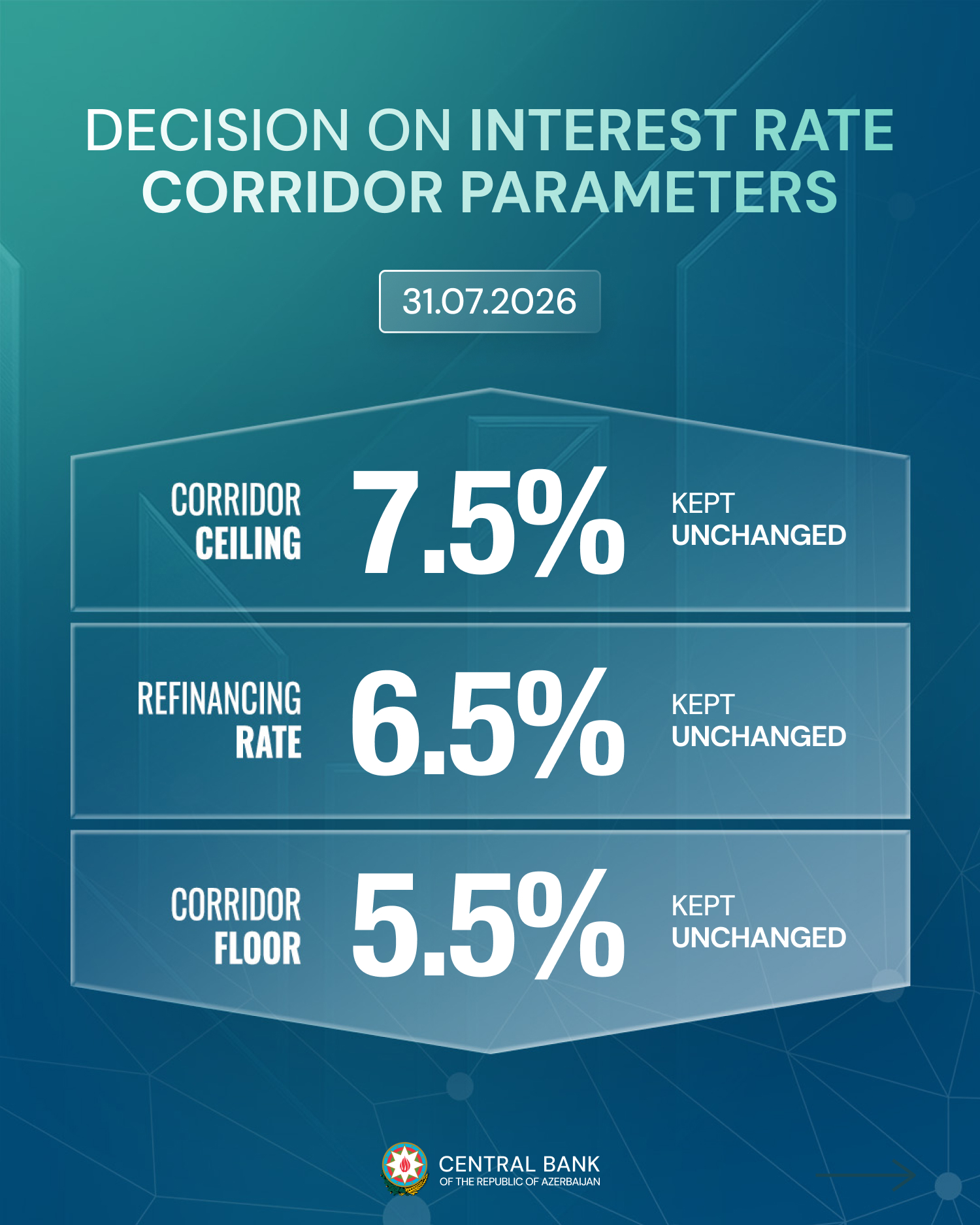
31 July 2026, Baku: The Management Board of the Central Bank of the Republic of Azerbaijan decided to keep all parameters of the interest rate corridor unchanged. The decision was made considering the dynamics of actual and forecasted inflation and domestic financial market developments. The upward revision to inflation forecast supports a tighter monetary policy stance on the one hand, the significant excess of foreign exchange supply over demand supports a more accommodative policy stance, on the other. The offsetting effects of these factors justify keeping the parameters of the interest rate corridor unchanged.
Annual inflation remains within the target range and moves in line with the projected trajectory under the baseline scenario. In June 2026, annual inflation stood at 5.8%. Annual price growth amounted to 7.1% for food, alcoholic beverages and tobacco products, 5.6% for paid services and 3.8% for non-food products. Annual core inflation stood at 5.5%.
Over the past period of current year, supply significantly prevailed over demand both in cash and cashless segments in the foreign exchange market. In H1 2026 cash foreign currency purchases by exchange points exceeded sales by $482M. The dollarization level of resident individuals’ deposits decreased by 3.8 percentage points 25.6% year-over-year in June 2026.
The Central Bank absorbed surplus in the foreign exchange market against the backdrop of a sharp decline in demand and a marked increase in foreign exchange supply. Over the past period of the current year, foreign exchange reserves of the Central Bank increased by 19.5% ($2.2B) to $13.8B.
The external sector indicators remained favorable. According to the State Customs Committee, the trade surplus amounted to $8B in H1 2026. Preliminary data show that, in January-June net remittances (the difference between inflows and outflows) amounted to $540.6M (year-over-year up by 82.8%). The Central Bank revised up its current account surplus forecast for end-2026 and 2027, driven by higher global energy prices and positive trends in non-hydrocarbon exports of goods and services.
Monetary policy tools are applied in response to financial market developments and liquidity indicators of the banking system. In the unsecured money market, short-term interest rates are formed within the Central Bank’s interest rate corridor. The average daily AZIR rate stood at 6.43% in May and June and 6.39% in the past period of July. Excluding required reserves, the banking sector's structural liquidity surplus (the difference between the Central Bank's liabilities to banks and its claims on the banking system) reached AZN6B by the end of the first half of 2026 (up by 2.1 times compared with December of the previous year). This points to ample lending capacity in the banking sector. The Central Bank uses 7-day deposit operations to manage liquidity, which accounted for 84.3% of the sterilization portfolio of open market operations as of the end of June. The Central Bank also holds regular note auctions. Over the past three months, yields on Central Bank notes declined across all maturities. A decline was also observed in the medium- and long-term segments of the yield curve. At the same time, interest rates on newly attracted manat-denominated term deposits declined in June 2026 compared with July 2025 (when the policy rate was cut).
The Central Bank forecasts that annual inflation will remain within the target range in the medium run. Under the July baseline scenario, annual inflation is expected to stand at 6.1% at the end of 2026, at 6% within 12 months (end of June 2027), and at 5.8% at the end of 2027. Hence, annual inflation is expected to return to the target in the second half of 2027. Note that the deviation of forecasted inflation from the target at the end of 2026 is within the forecast error. The upward revision to the inflation forecast primarily reflects the intensified impact of direct and indirect external cost factors, which are expected to be transitory over the medium term.
Risks to the inflation outlook remain tilted to the upside, reflecting rising energy and food prices against the backdrop of heightened global geopolitical tensions, as well as the risk of imported inflation from trading partners. The pass-through of external inflationary pressures to domestic prices will also depend on dynamics of the nominal effective exchange rate of the manat. Future revisions to the Central Bank's inflation projections will largely depend on the extent to which these risks materialize. Under the current fiscal and monetary policy stance, the likelihood that domestic demand will generate significant inflationary pressures remains limited.
The Central Bank's decisions on the parameters of the interest rate corridor will remain data-dependent and will be based on the inflation outlook and the evolution of macroeconomic conditions. Given elevated uncertainty in the global environment, the Central Bank will continue to assess macroeconomic projections under alternative scenarios. In taking decisions on the parameters of the interest rate corridor, the Central Bank will take into account developments in the foreign exchange market and banking sector liquidity, while closely monitoring the persistence of appreciation pressures on the manat and the magnitude of excess foreign exchange supply.
The next decision on the interest rate corridor parameters will be made public on 23 September 2026.
31.07.2026